
LessonSeries and parallel circuits · 14 min
Series circuits
Parts are in series when they are connected end to end, so there is only one path for the current. A fuse, a switch and the lamp they control; an LED and its resistor; the cells in a torch - all in series.
The three rules of a series circuit
- The same current flows through every part (there is nowhere else for it to go).
- The resistances add up: the current has to get through all of them.
- The voltages add up to the supply, and each part's share is in proportion to its resistance (V = I × R with the same I).
- Rtotal
- the single resistance that would draw the same current
- I
- the one current through every part
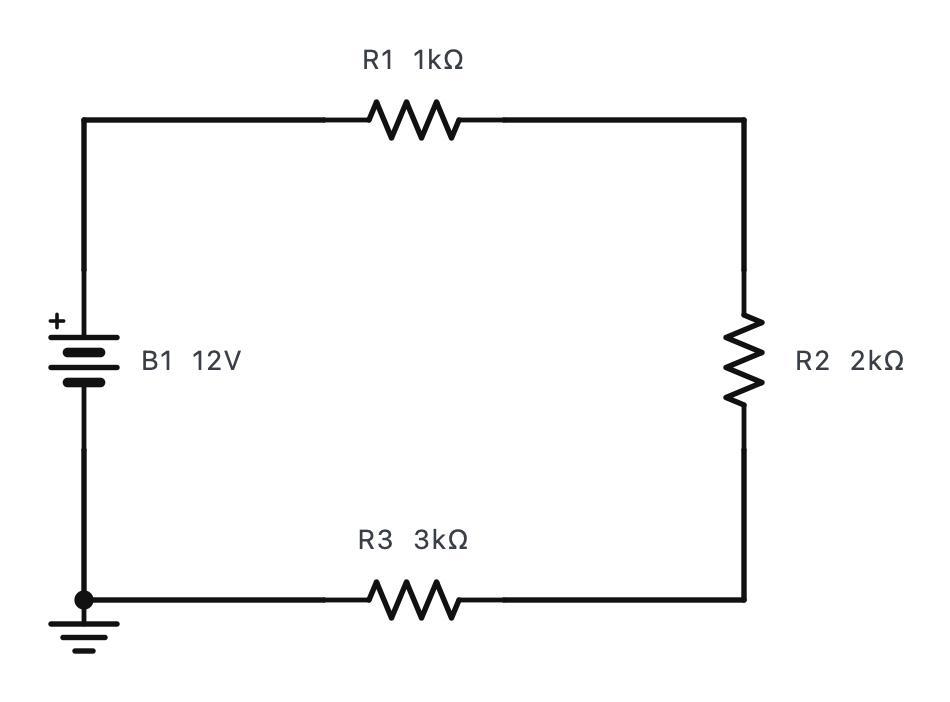
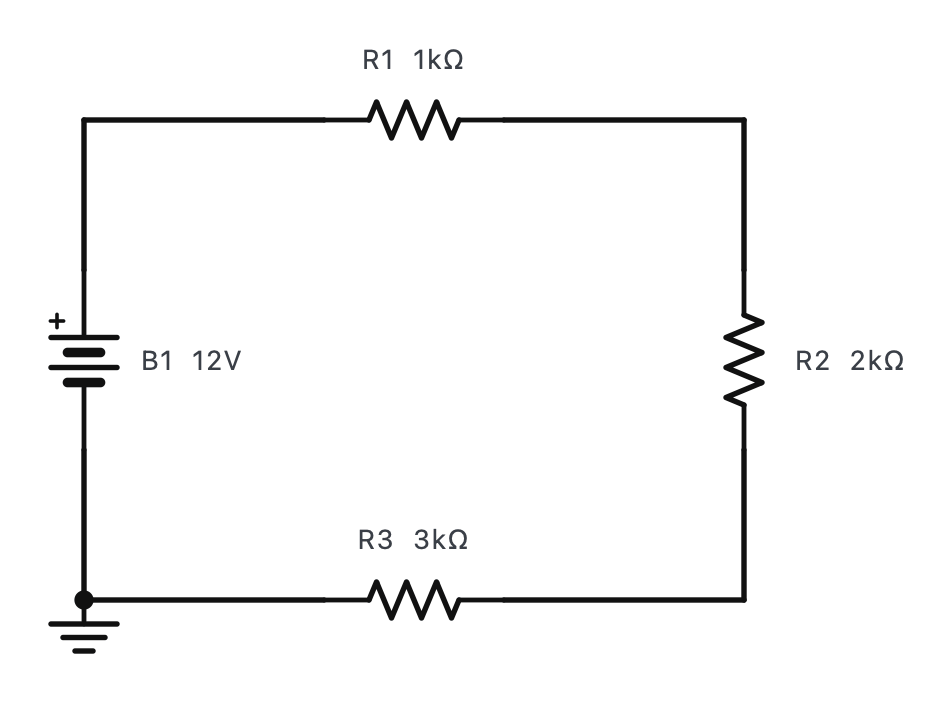
R1 = 1 kΩ, R2 = 2 kΩ and R3 = 3 kΩ are in series across 12 V. Find the current and each voltage.
- Rtotal = 1 + 2 + 3 = 6 kΩ.
- I = 12 V / 6 kΩ = 2 mA.
- V1 = 2 mA × 1 kΩ = 2 V, V2 = 2 × 2 = 4 V, V3 = 2 × 3 = 6 V.
- Check: 2 + 4 + 6 = 12 V - the whole supply, shared out.
Answer: 2 mA everywhere; 2 V, 4 V and 6 V.
Make R2 ten times bigger than the others: it takes almost all the voltage.
Where you meet it
Two 1.5 V cells in series give 3 V: in series, voltages add.
The resistor sets the one current that flows through both.
Always in series with what they switch or protect.
A shunt resistor in series sees the same current as the load.
Practice 1470 Ω, 1 kΩ and 2.2 kΩ are in series. What is the total resistance?
Show the answer
Answer: 3670 Ω
470 + 1000 + 2200 = 3670 Ω.
Practice 2Those three resistors are across 11 V. What voltage is across the 2.2 kΩ?
Hint
First the current, I = V / Rtotal.
Show the answer
Answer: 6.594 V
I = 11 / 3670 = 3.0 mA. V = 0.0030 × 2200 = 6.59 V.
Practice 3In a series circuit of a battery and three lamps, one lamp's filament breaks. The others:
- Get brighter
- Stay as they were
- Go out
- Get dimmer but stay on
Show the answer
Answer: C. Go out
The only path is broken, so the current stops everywhere.
Challenge 4Two 12 V 5 W lamps are connected in series across 12 V. Assuming each keeps a fixed resistance, what power does each lamp give?
Hint
Each lamp's resistance is V² / P. Then the series current.
Show the answer
Answer: 1.25 W
R = 144 / 5 = 28.8 Ω each, 57.6 Ω in all. I = 12 / 57.6 = 0.208 A. P = 0.208² × 28.8 = 1.25 W each: half the voltage gives a quarter of the power. (A real filament, cooler, would have a lower resistance and glow a little more.)