
LessonOhm's law · 15 min
Ohm's law: V = I × R
In 1827 Georg Ohm measured the current through wires at different voltages and found a simple rule: for a given conductor at a steady temperature, the current is proportional to the voltage. Double the push, double the flow. The constant that links them is the resistance. This one law answers most of the questions you will ever ask about a circuit.
- V
- the voltage across the part (V)
- I
- the current through it (A)
- R
- its resistance (Ω)
Rearranged, the same law gives whichever of the three you do not know:
- I = V / R - the current, from the voltage and the resistance
- R = V / I - the resistance, from a voltage and a current you measured
- V = I × R - the voltage a current makes across a resistance
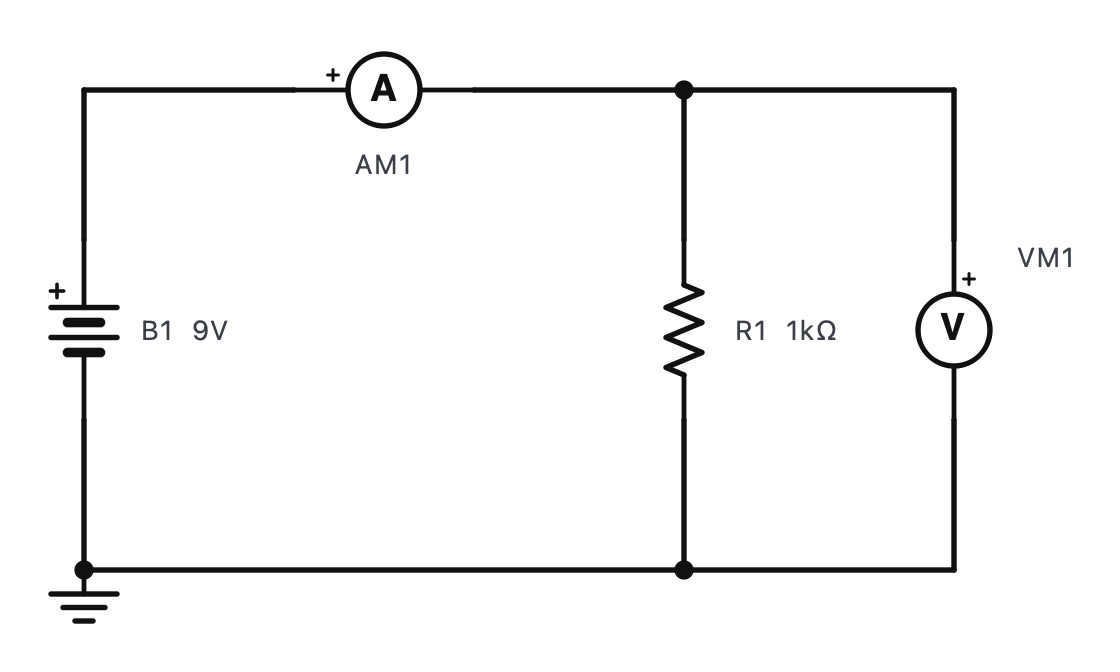
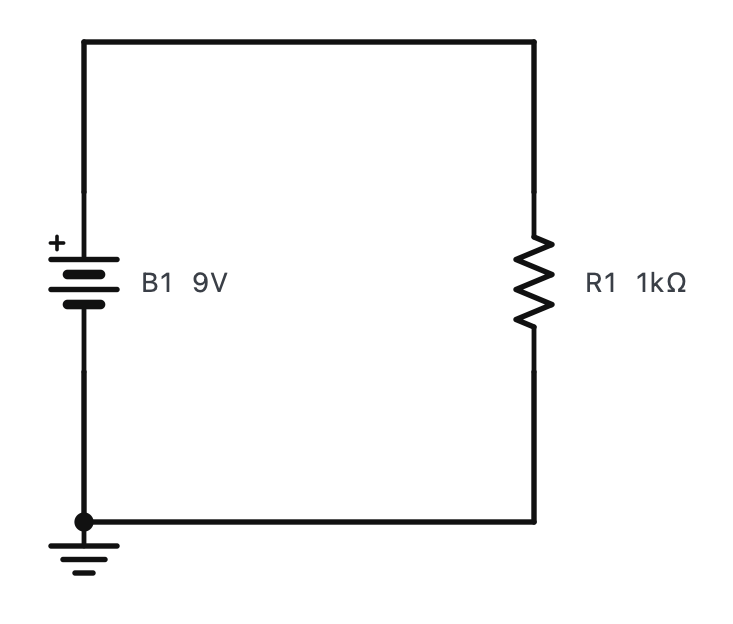
A 1 kΩ resistor is connected across a 9 V battery. What current flows?
- I = V / R = 9 V / 1000 Ω.
- I = 0.009 A = 9 mA.
Answer: 9 mA.
A kettle's heating element on the 230 V mains draws 8.7 A. What is its resistance?
- R = V / I = 230 V / 8.7 A.
- R = 26.4 Ω.
Answer: About 26 Ω - a small resistance, so a big current flows and a lot of heat is made.
Each resistor gives a straight line through zero: that is what "proportional" looks like. The smaller the resistance, the steeper the line - more current for the same voltage.
Double V and the current doubles; double R and it halves.
Where you meet it
Every indicator LED has a resistor sized with Ohm's law to give it about 10 - 20 mA.
Chargers and power meters pass the current through a small known resistor and measure the voltage: I = V / R.
Kettles, irons and soldering irons: R sets the current, and so the heat.
Measure a voltage and a resistance and you know the current - without breaking the circuit.
Practice 1What current flows when 12 V is across 4.7 kΩ?
Hint
mA = V / kΩ.
Show the answer
Answer: 2.553 mA
I = 12 / 4.7 = 2.55 mA.
Practice 2What resistance lets exactly 25 mA flow from a 5 V supply?
Hint
R = V / I, with I in amps.
Show the answer
Answer: 200 Ω
R = 5 / 0.025 = 200 Ω.
Practice 315 mA flows through a 330 Ω resistor. What voltage is across it?
Hint
V = I × R.
Show the answer
Answer: 4.95 V
V = 0.015 × 330 = 4.95 V.
Challenge 4When the voltage across a resistor is raised by 6 V, its current rises from 2 mA to 5 mA. What is its resistance, in kΩ?
Hint
For a resistor, the change in V divided by the change in I is R too.
Show the answer
Answer: 2 kΩ
ΔI = 3 mA for ΔV = 6 V, so R = 6 / 3 = 2 kΩ. (It started at 2 mA × 2 kΩ = 4 V and ended at 10 V.)