
LessonPower sources and safety · 14 min
Bench supplies, adapters and the current limit
A bench power supply is the electronics workshop's adjustable battery - with one feature that saves many circuits: a current limit.
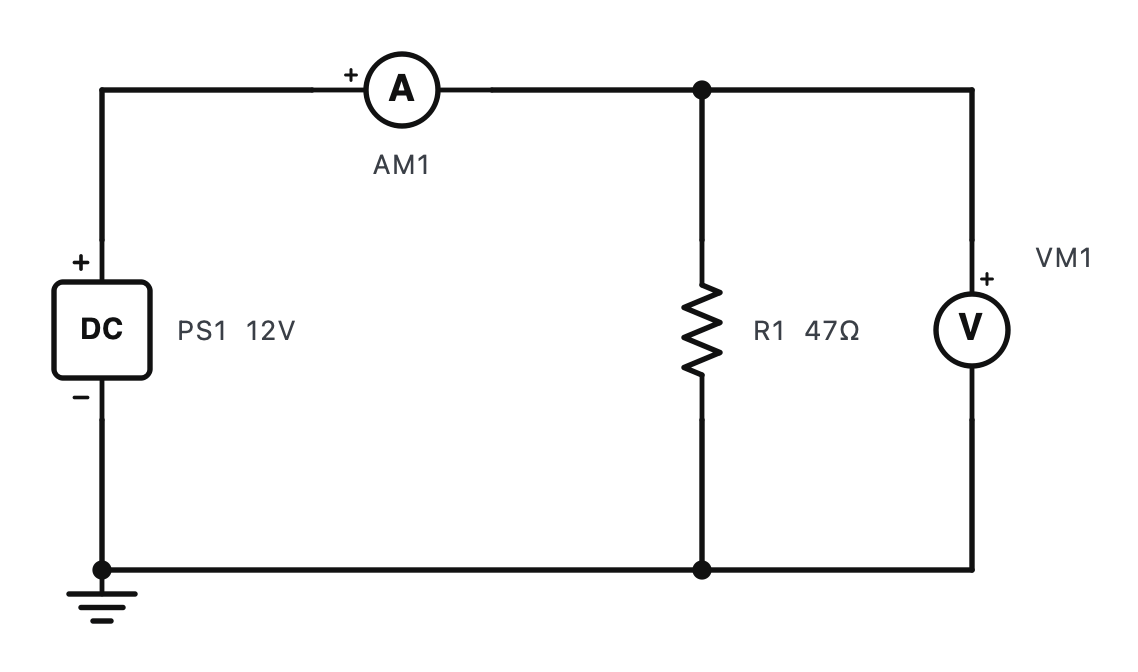
Constant voltage and constant current
- You set a voltage (say 12 V) and a current limit (say 100 mA).
- While the load takes less than the limit, the supply holds the voltage: CV (constant voltage) mode, like a perfect battery.
- If the load tries to take more, the supply lowers its voltage just enough to hold the current at the limit: CC (constant current) mode, and the CC light comes on.
Adapters and chargers
A wall adapter marked "12 V 2 A" gives 12 V and can supply up to 2 A. The load takes what it needs. So the rules for choosing one are simple:
- The voltage must match what the device needs.
- The current rating must be at least what the device draws (more is fine).
- The polarity of the plug must match (look for the centre-positive or centre-negative symbol).
Making one voltage from another: regulators (a preview)
- Linear regulator (7805, LM317, AMS1117): simple and quiet, but it burns the extra voltage as heat: P = (Vin − Vout) × I.
- Switching (buck) converter (LM2596 modules, phone chargers): 85 - 95 % efficient, so it stays cool even when stepping 24 V down to 5 V.
A 7805 makes 5 V at 0.5 A from a 12 V battery. How much heat does it make?
- It drops 12 − 5 = 7 V.
- P = 7 V × 0.5 A = 3.5 W.
Answer: 3.5 W - it needs a heatsink. A buck module would waste well under 0.5 W.
Where you meet it
A current-limited supply powers a suspect board without letting a fault burn it.
5 V by default; USB Power Delivery chargers negotiate 9, 15 or 20 V with the device first.
Limit the charging current into the battery - CC, then CV, like a bench supply.
Practice 1A supply set to 10 V with a 200 mA limit feeds 100 Ω. Which mode is it in, and what current flows?
- CV, 100 mA
- CC, 200 mA
- CV, 200 mA
- CC, 100 mA
Show the answer
Answer: A. CV, 100 mA
10 / 100 = 100 mA, under the limit: CV.
Practice 2The same supply (10 V, 200 mA limit) feeds 20 Ω. What voltage does it show?
Show the answer
Answer: 4 V
20 Ω would need 500 mA: CC at 200 mA. V = 0.2 × 20 = 4 V.
Practice 3A router needs 12 V 1.5 A. Which adapter is right?
- 9 V 2 A
- 12 V 1 A
- 12 V 2 A
- 19 V 3 A
Show the answer
Answer: C. 12 V 2 A
Same voltage, at least the current.
Challenge 4A buck converter makes 5 V 2 A from a 12 V battery at 90 % efficiency. What current does it take from the battery?
Hint
Output power / efficiency = input power.
Show the answer
Answer: 0.926 A
Pout = 10 W; Pin = 10 / 0.9 = 11.1 W; I = 11.1 / 12 = 0.93 A - less than the 2 A coming out. (A 7805 would take the full 2 A from the battery.)