
LessonWhat electricity is · 15 min
Current and voltage
Two quantities describe what happens in every circuit. Current is how much charge flows past a point each second. Voltage is the push that makes it flow. Learn to keep them apart: almost every beginner's confusion comes from mixing them up.
Current: the flow of charge
- I
- the current, in amperes (A)
- Q
- the charge that passes, in coulombs (C)
- t
- the time it takes, in seconds (s)
One ampere is one coulomb per second. Small currents are given in milliamperes (1 mA = 0.001 A) or microamperes (1 µA = 0.000001 A).
- Current only flows round a closed loop. Open the loop anywhere - a switch, a broken wire - and it stops everywhere at once.
- In a single loop the current is the same at every point. It is not used up on the way: the lamp takes energy from the charge, not the charge itself.
- By convention current flows from + round the circuit to −. The electrons actually drift the other way (− to +) - a historical accident. All circuit diagrams and calculations use the conventional direction, so we do too.
Voltage: the push between two points
A battery gives each coulomb of charge that passes through it some energy. Voltage (or potential difference) is that energy per coulomb. A 12 V battery gives 12 joules to every coulomb; the charge hands that energy over to the lamp as it passes through.
- V
- the voltage, in volts (V)
- E
- the energy, in joules (J)
- Q
- the charge, in coulombs (C)
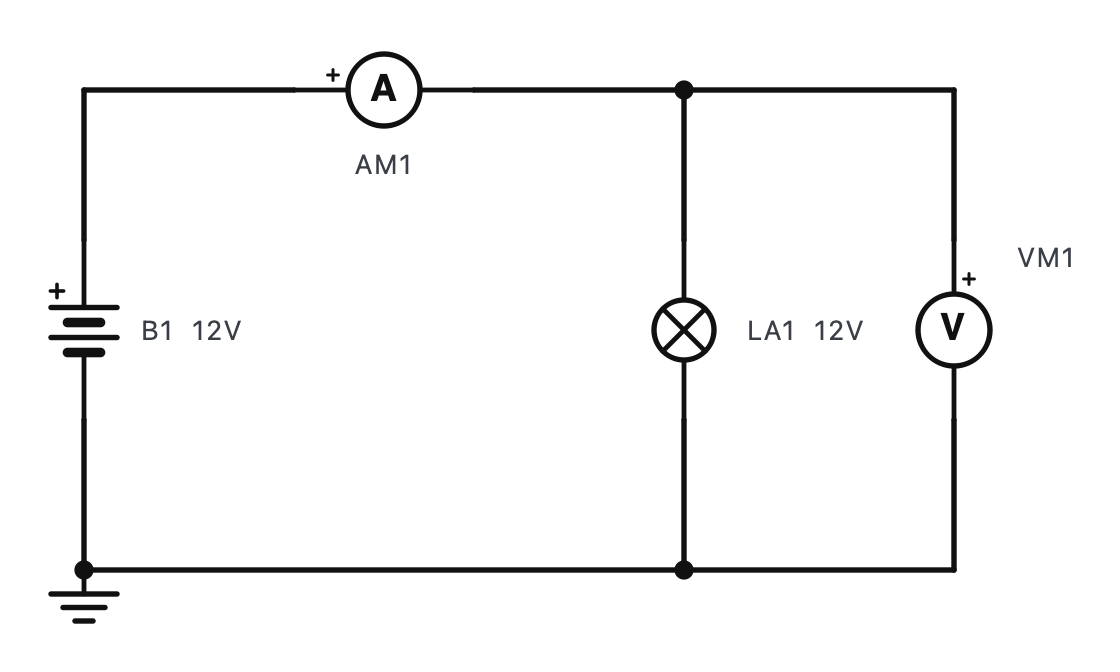
The water analogy - useful, if used carefully
| Water system | Circuit |
|---|---|
| A pump | The battery: it creates the push |
| Pressure difference between two points | Voltage (V) |
| Flow rate (litres per second) | Current (A) |
| A narrow section of pipe | A resistance: it limits the flow |
| A closed loop of pipe | A closed circuit |
| Thing | Typical voltage | Typical current |
|---|---|---|
| Red indicator LED | about 2 V across it | 5 - 20 mA |
| AA cell / Li-ion phone cell | 1.5 V / 3.7 V | up to about 2 A |
| USB phone charger | 5 V | 1 - 3 A |
| ESP32 board on Wi-Fi | 3.3 V | 80 - 250 mA |
| Motorbike or solar battery | 12 V | a few A; 100 A+ for a starter motor |
| Electric kettle on the mains | 230 V AC | about 9 A |
A charger pushes 2 A into a phone for 30 minutes. How much charge flows, and how much energy does it deliver at 5 V?
- t = 30 min = 30 × 60 = 1800 s.
- Q = I × t = 2 A × 1800 s = 3600 C.
- E = V × Q = 5 V × 3600 C = 18 000 J = 18 kJ.
Answer: 3600 C of charge, carrying 18 kJ of energy.
Practice 10.5 A flows for 10 s. How much charge has passed?
Hint
Q = I × t.
Show the answer
Answer: 5 C
Q = 0.5 × 10 = 5 C.
Practice 2How much energy does a 9 V battery give to 5 C of charge?
Hint
E = V × Q.
Show the answer
Answer: 45 J
E = 9 × 5 = 45 J.
Practice 3A battery drives a current round a loop through two lamps. Where is the current largest?
- Just after the battery's +
- Between the two lamps
- Just before the battery's −
- It is the same everywhere in the loop
Show the answer
Answer: D. It is the same everywhere in the loop
In a single loop the current is the same at every point. The lamps take energy, not charge.
Challenge 4A 3.7 V phone battery supplies 1.5 A for 2 hours. How much energy has it delivered, in kJ?
Hint
First the charge: Q = I × t with t in seconds. Then E = V × Q.
Show the answer
Answer: 39.96 kJ
t = 2 × 3600 = 7200 s. Q = 1.5 × 7200 = 10 800 C. E = 3.7 × 10 800 = 39 960 J ≈ 40 kJ.