
LessonReal resistors: values, codes and tolerance · 16 min
Standard values, tolerance and resistor types
You worked out that an LED needs 467 Ω - but nobody sells 467 Ω. Resistors come in a small set of preferred values, the E-series, and choosing among them sensibly is part of every design.
Why these numbers?
A 10 % resistor marked 100 Ω may be anything from 90 to 110 Ω. There is no point selling a 105 Ω part as well: the ranges would overlap. So the values are spaced so each one's tolerance band just meets the next - the same ratio apart, not the same number of ohms. For 12 values per decade (E12) each step is about 21 % (the 12th root of 10 = 1.21), and the pattern repeats in every decade: 10 Ω, 100 Ω, 1 kΩ, 10 kΩ...
| Series | Tolerance | Values in each decade |
|---|---|---|
| E6 | ±20 % | 10 15 22 33 47 68 |
| E12 | ±10 % | 10 12 15 18 22 27 33 39 47 56 68 82 |
| E24 | ±5 % (±1 %) | 10 11 12 13 15 16 18 20 22 24 27 30 33 36 39 43 47 51 56 62 68 75 82 91 |
| E96 | ±1 % | 96 values: 100 102 105 107 110 113 115 118 121 124 127 130 ... 953 976 |
Tolerance: designing for the worst case
Every resistor is somewhere inside its tolerance band. Where precision matters - a battery gauge, a voltage reference, a sensor - work out the worst case.
10 k / 10 k on 10 V should give 5.00 V. With ±5 % resistors, how far off can it be?
- Highest: R2 high (10.5 k), R1 low (9.5 k): 10 × 10.5 / 20 = 5.25 V.
- Lowest: R2 low (9.5 k), R1 high (10.5 k): 10 × 9.5 / 20 = 4.75 V.
Answer: 4.75 - 5.25 V: ±5 %. With 1 % parts: ±1 %. For a battery gauge, use 1 % metal film - the extra cost is tiny.
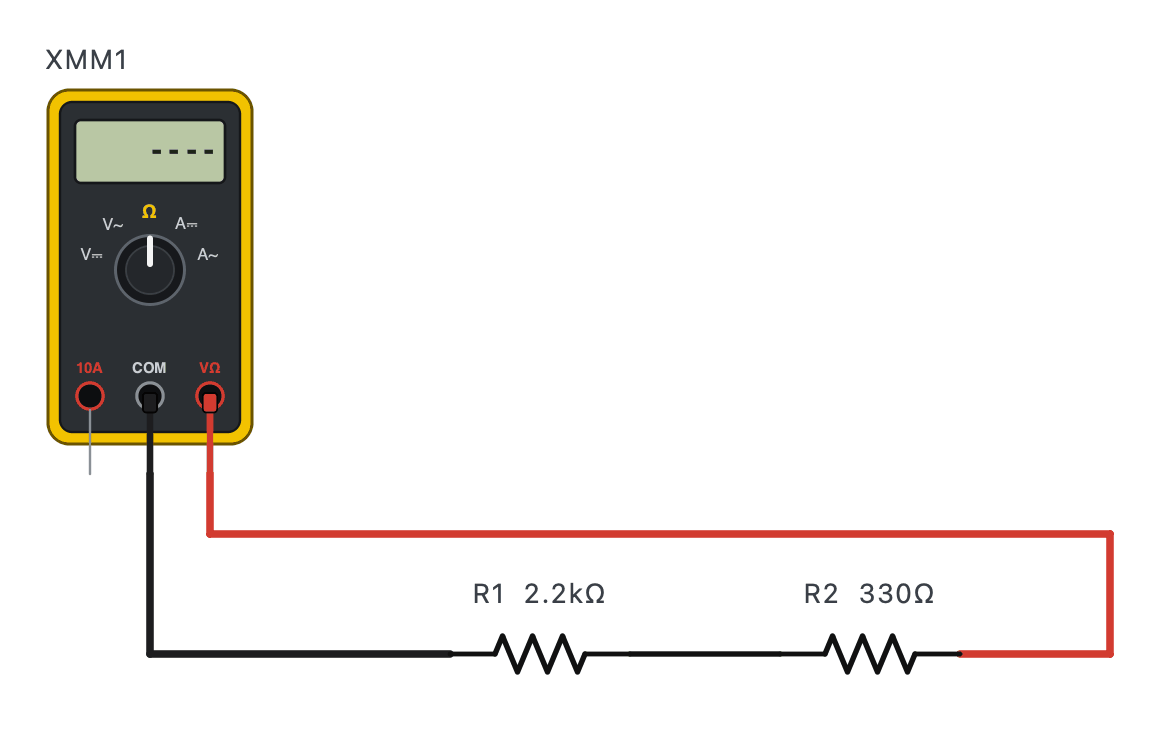
Making a value you do not have
Kinds of resistor
| Type | Typical | Where it is used |
|---|---|---|
| Carbon film (beige body) | 5 %, 1/4 W, cheap | General use in kits and older designs |
| Metal film (blue body) | 1 %, low noise, stable | Today's default through-hole resistor |
| Thick-film SMD (0402 - 2512) | 1 % or 5 % | Almost every modern circuit board |
| Wirewound / ceramic "cement" | 5 - 10 W and more | Power supplies, dummy loads, motor circuits |
| Current-sense (milliohm) | 0.001 - 0.1 Ω, 1 % | Chargers, battery monitors, motor drivers |
Practice 1Your calculation gives 5 kΩ. Which E12 value is nearest?
- 4.7 kΩ
- 5.1 kΩ
- 5.6 kΩ
- 6.8 kΩ
Show the answer
Answer: A. 4.7 kΩ
E12 has 4.7 k and 5.6 k (5.1 k is E24). 4.7 k is 6 % away, 5.6 k is 12 % away.
Practice 2What is the lowest value a 1 kΩ ±5 % resistor may have?
Show the answer
Answer: 950 Ω
1000 − 5 % = 950 Ω.
Practice 3Which pair in series gives closest to 7.5 kΩ using only E12 values?
- 6.8 k + 680 Ω
- 5.6 k + 1.5 k
- 4.7 k + 2.2 k
- 3.3 k + 3.3 k
Show the answer
Answer: A. 6.8 k + 680 Ω
6.8 k + 0.68 k = 7.48 kΩ (0.3 % low). The others give 7.1, 6.9 and 6.6 kΩ.
Challenge 4An LED (2.0 V) runs from 9 V through a 470 Ω ±5 % resistor. What is the HIGHEST current it may get, in mA?
Hint
The most current flows with the lowest resistance.
Show the answer
Answer: 15.68 mA
Rmin = 470 × 0.95 = 446.5 Ω. I = 7.0 / 446.5 = 15.7 mA - still safe for a 20 mA LED.
Challenge 5A 1 % resistor of 100 ppm/°C measures exactly 10.00 kΩ at 25 °C. What is its resistance at 75 °C?
Hint
100 ppm = 0.01 % per °C.
Show the answer
Answer: 10050 Ω
50 °C × 0.01 % = 0.5 %: 10.00 k × 1.005 = 10.05 kΩ.