
LessonPower sources and safety · 15 min
Internal resistance: why the voltage sags under load
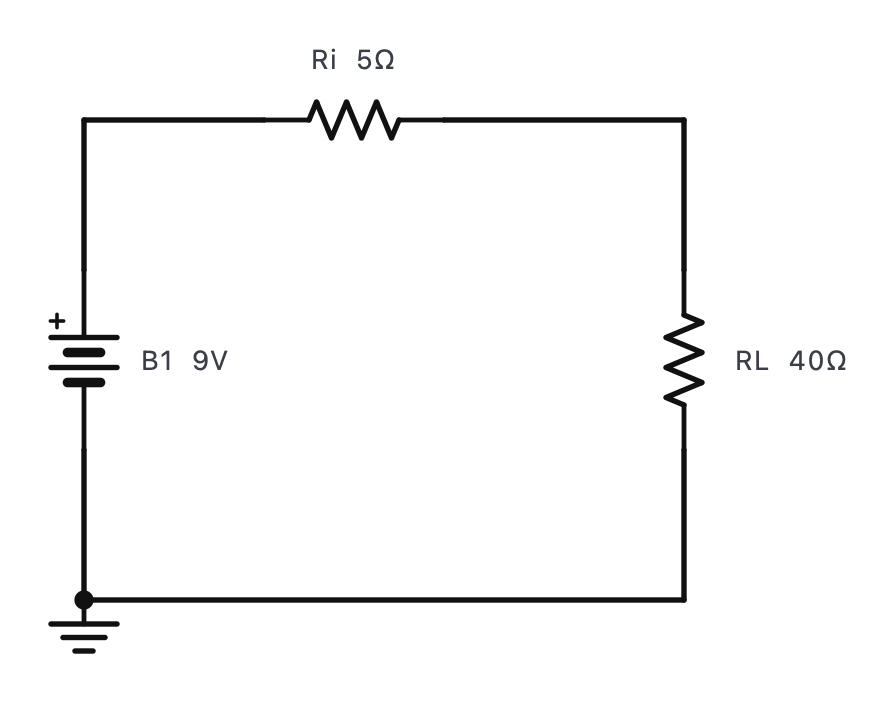
Measure a motorbike battery with a meter: 12.5 V, looks fine. Press the starter: nothing but a click. The battery is not lying - the meter draws almost no current, and a battery's weakness only shows when current flows. Every real source has an internal resistance r, and the current through it costs voltage.
- E
- the open-circuit voltage (no current): the "EMF"
- I
- the current being drawn
- r
- the internal resistance
- Ishort
- the current if the terminals are shorted
| Source | Typical r | Short-circuit current |
|---|---|---|
| 9 V PP3 alkaline | 1 - 2 Ω | a few amps |
| AA alkaline (new) | 0.1 - 0.3 Ω | about 10 A |
| 18650 Li-ion cell | 0.02 - 0.05 Ω | 100 A or more |
| Car / motorbike battery | 0.005 - 0.02 Ω | hundreds to thousands of amps |
A 12.6 V battery feeds a starter motor that draws 150 A. What reaches the motor if r = 0.01 Ω (healthy) and r = 0.05 Ω (old, sulphated)?
- Healthy: 12.6 − 150 × 0.01 = 11.1 V.
- Old: 12.6 − 150 × 0.05 = 5.1 V - too little to turn the engine.
Answer: 11.1 V and 5.1 V. Both batteries read 12.6 V on a meter with no load. Garages use a load tester.
Measuring r
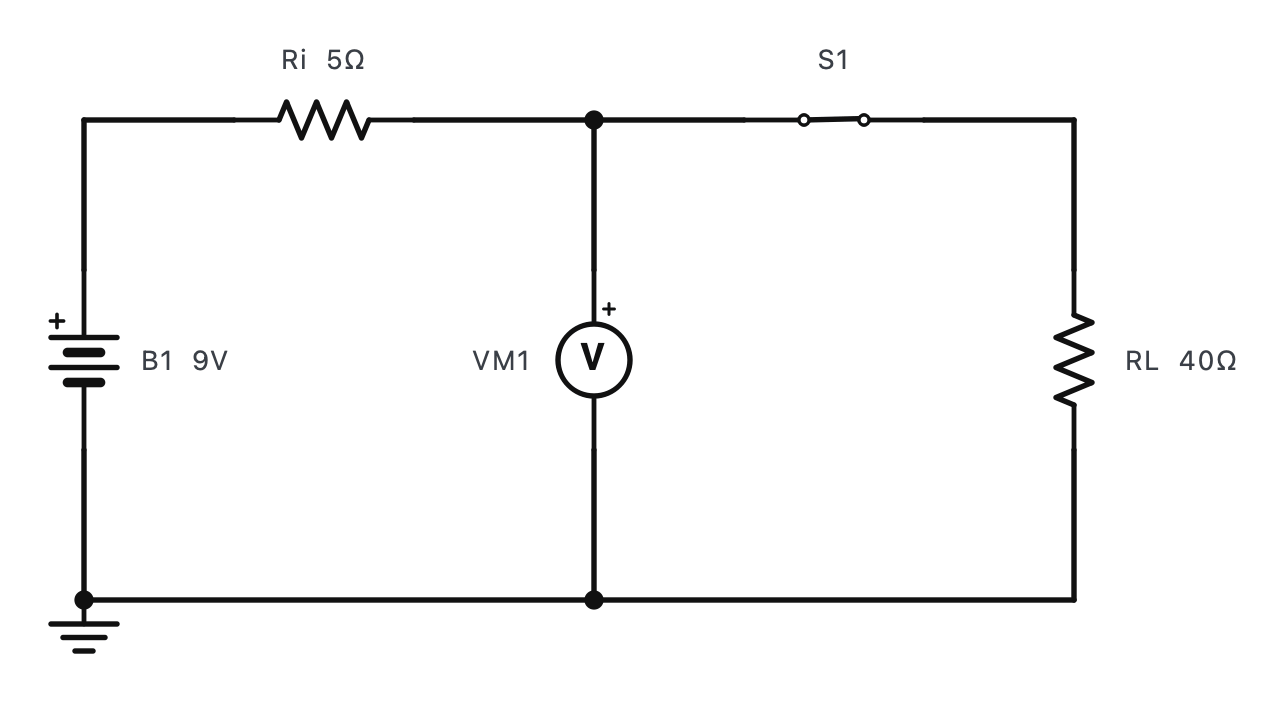
Measure the voltage with no load (that is E), then with a known load current: r = (E − Vloaded) / I. You will do exactly this in the lab.
The load gets the most power when RL = r - but then half the energy heats the battery. Real designs keep RL much bigger than r.
Where you meet it
A load test (a big current for a few seconds) shows r; a plain voltmeter cannot.
Put a big capacitor near a GSM module or a motor so short current bursts do not pull the supply down through the battery's r.
A low-r battery shorted by a spanner or a ring delivers enormous current.
Practice 1A battery reads 9.0 V with no load and 8.4 V while 0.3 A flows. What is its internal resistance?
Show the answer
Answer: 2 Ω
r = (9.0 − 8.4) / 0.3 = 2 Ω.
Practice 2An 18650 cell (4.1 V, r = 0.04 Ω) supplies 5 A. What is its terminal voltage?
Show the answer
Answer: 3.9 V
4.1 − 5 × 0.04 = 3.9 V.
Practice 3What current flows if a 12.6 V battery with r = 0.01 Ω is short-circuited?
Show the answer
Answer: 1260 A
12.6 / 0.01 = 1260 A - enough to weld metal.
Challenge 4A battery gives 11.8 V into a 10 Ω load and 11.0 V into a 2 Ω load. Find its internal resistance.
Hint
Two equations: E = V + I r with I = V / R for each load.
Show the answer
Answer: 0.1852 Ω
I1 = 11.8 / 10 = 1.18 A, I2 = 11.0 / 2 = 5.5 A. E = 11.8 + 1.18 r = 11.0 + 5.5 r, so 0.8 = 4.32 r and r = 0.185 Ω (and E = 12.0 V).