
LessonPower and energy · 13 min
Heat in resistors and power ratings
Every watt a resistor takes becomes heat. The resistor warms up until it loses heat to the air and the board as fast as it makes it. Too much power and it gets hot enough to discolour, drift in value, unsolder itself, crack or burn - and sometimes the circuit board around it. Each resistor therefore has a power rating: the most it can safely handle.
| Resistor | Typical rating |
|---|---|
| Small through-hole (the common one) | 1/4 W (0.25 W) |
| Larger through-hole | 1/2 W, 1 W, 2 W |
| Ceramic "cement" or wirewound power resistor | 5 W, 10 W and more |
| SMD 0402 / 0603 / 0805 / 1206 | 1/16 W / 1/10 W / 1/8 W / 1/4 W |
| SMD 2512 | 1 W - 2 W |
The 470 Ω resistor for a red LED on 9 V carries 15 mA. Which power rating?
- Its voltage is 9 − 2 = 7 V (not 9 V - the LED takes 2 V).
- P = V × I = 7 × 0.015 = 0.105 W.
- A 1/4 W resistor gives a margin of 0.25 / 0.105 = 2.4×.
Answer: 1/4 W is fine.
A 9 V, 300 mA radio is to run from a 12 V battery through a series resistor. Which resistor, and which rating?
- The resistor must drop 12 − 9 = 3 V at 0.3 A: R = 3 / 0.3 = 10 Ω.
- P = V × I = 3 × 0.3 = 0.9 W.
- With a 2× margin: a 2 W resistor.
Answer: 10 Ω, 2 W. But the radio's current rises and falls with the volume, and the resistor's drop with it - a voltage regulator does this job much better.
Where you meet it
Big ceramic 5 W - 10 W resistors limit the switch-on surge or slowly empty capacitors after power-off (bleeder resistors).
Low-value shunts (0.01 - 0.1 Ω) carry amps; their rating is chosen with P = I² R.
Technicians test a battery or power supply into a known power resistor - a "dummy load" - and watch the voltage.
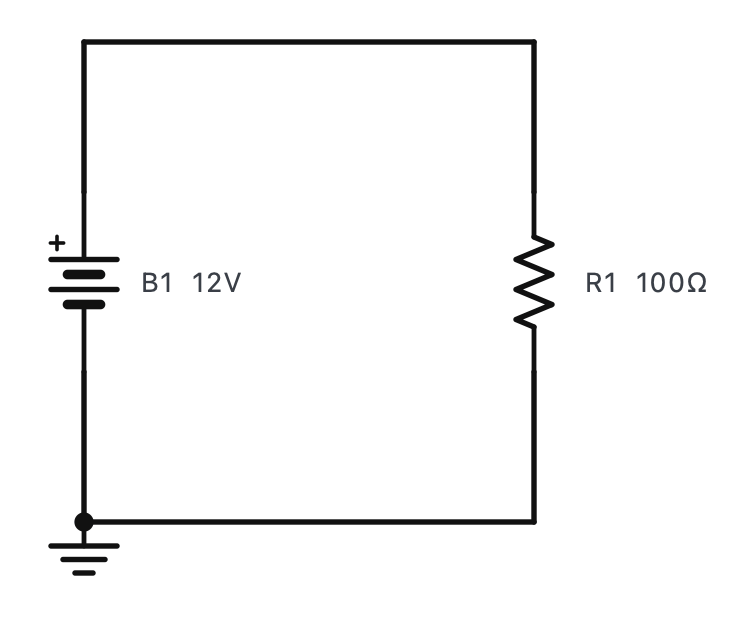
Practice 10.1 A flows through a 100 Ω resistor. What power rating would you choose (with a 2× margin)?
- 1/4 W
- 1/2 W
- 1 W
- 2 W
Hint
P = I² R, then double it.
Show the answer
Answer: D. 2 W
P = 0.1² × 100 = 1 W. With a 2× margin: 2 W.
Practice 2What is the largest voltage a 1/4 W, 1 kΩ resistor can take (at its full rating)?
Hint
P = V² / R, so V = √(P × R).
Show the answer
Answer: 15.81 V
V = √(0.25 × 1000) = √250 = 15.8 V.
Challenge 3A 47 Ω resistor is rated 0.5 W. Keeping a 2× margin (use at most half the rating), what is the largest current it should carry, in mA?
Hint
Allowed power = 0.25 W. I = √(P / R).
Show the answer
Answer: 72.9 mA
I = √(0.25 / 47) = √0.005319 = 0.0729 A = 72.9 mA.