
LessonPower and energy · 15 min
Power: how fast energy is used
A phone charger is "10 W", a kettle "2000 W", a resistor "1/4 W". Power is the rate at which energy is delivered or turned into something else - light, heat, motion. It decides how hot parts get, how big the battery must be and what the electricity bill says.
- P
- the power, in watts (W); 1 W = 1 joule per second
- V
- the voltage across the part (V)
- I
- the current through it (A)
Why V × I? Voltage is the energy each coulomb carries (J/C) and current is how many coulombs pass each second (C/s). Multiply them and you get joules per second: watts.
Two more forms, from Ohm's law
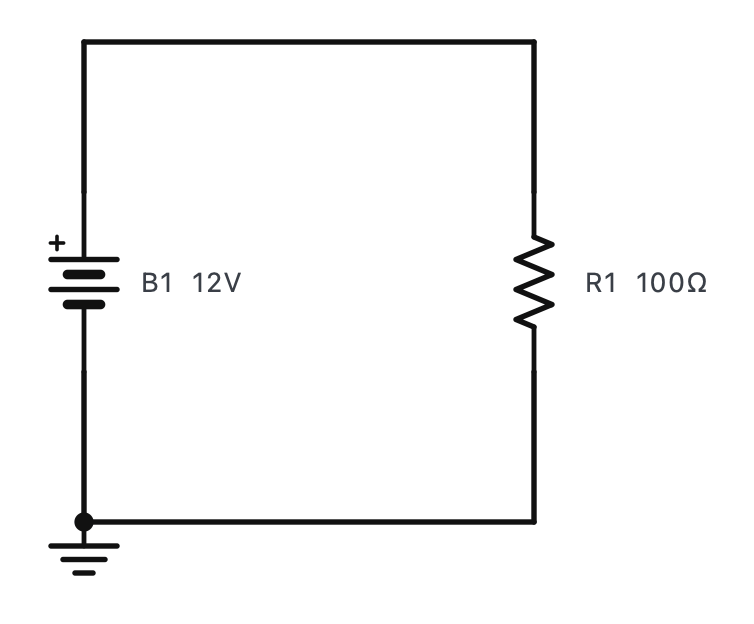
For a resistance, put V = I × R or I = V / R into P = V × I:
- I² × R
- use it when you know the current through the resistance
- V² / R
- use it when you know the voltage across the resistance
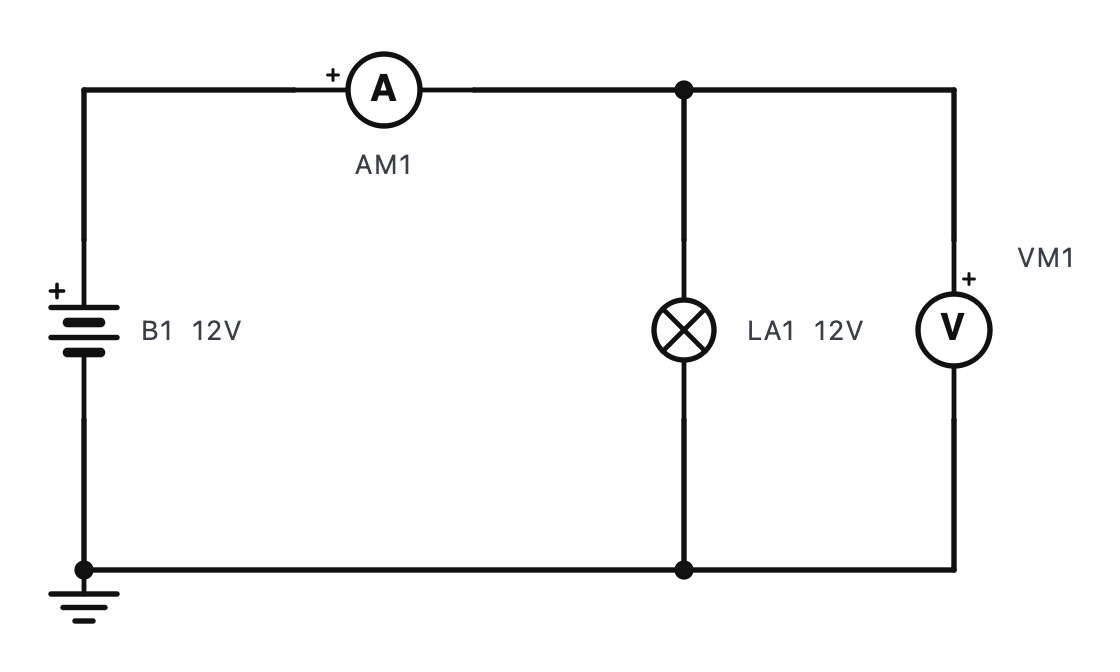
A lamp is marked 12 V 5 W. What current does it take, and what is its (hot) resistance?
- I = P / V = 5 / 12 = 0.417 A.
- R = V² / P = 144 / 5 = 28.8 Ω.
- Check: P = I² R = 0.417² × 28.8 = 5.0 W.
Answer: 0.417 A and 28.8 Ω.
How much power does a 1 kΩ resistor take across 9 V?
- P = V² / R = 81 / 1000.
- P = 0.081 W = 81 mW.
Answer: 81 mW - easily handled by a normal 1/4 W (250 mW) resistor.
Which makes more heat: a bigger or a smaller resistance? It depends what is fixed. On a fixed voltage (a battery, the mains), a smaller R takes more current and more power - a kettle element is only 26 Ω. With a fixed current (a series circuit), the bigger R takes more power - the poor connection in a cable gets hot.
Double the voltage: four times the power (V² / R).
| Device | Power |
|---|---|
| Phone charger | 10 - 25 W (fast chargers 65 W+) |
| LED bulb | 5 - 12 W |
| Ceiling fan | 50 - 75 W |
| LED TV (40 inch) | 50 - 100 W |
| Fridge (while its compressor runs) | 100 - 200 W |
| Electric iron | 1000 W |
| Electric kettle | 2000 W |
Where you meet it
"5 V 2 A" on a charger means up to 10 W.
P = I² R in the lines is wasted. Sending the same power at a higher voltage needs less current, so far less loss - which is why Ghana's grid carries power at 161 000 V and 330 000 V and steps it down near you.
Kettles, irons and water heaters are resistances chosen to turn electrical power into heat.
Practice 1A phone charger supplies 5 V at 2 A. What is its power?
Hint
P = V × I.
Show the answer
Answer: 10 W
P = 5 × 2 = 10 W.
Practice 2What current does a 60 W appliance take from 230 V?
Hint
I = P / V.
Show the answer
Answer: 0.261 A
I = 60 / 230 = 0.261 A.
Practice 320 mA flows through 220 Ω. How much power does the resistor take?
Hint
P = I² R with I in amps.
Show the answer
Answer: 0.088 W
P = 0.02² × 220 = 0.0004 × 220 = 0.088 W (88 mW).
Challenge 4A 230 V 1000 W iron is run on a 115 V supply. Assuming its resistance stays the same, what power does it give?
Hint
First its resistance: R = V² / P at 230 V. Then P at 115 V.
Show the answer
Answer: 250 W
R = 230² / 1000 = 52.9 Ω. At 115 V: P = 115² / 52.9 = 250 W. Half the voltage gives a quarter of the power (P = V² / R).