
LabSeries and parallel circuits · 18 min
Lab: series, parallel and Kirchhoff
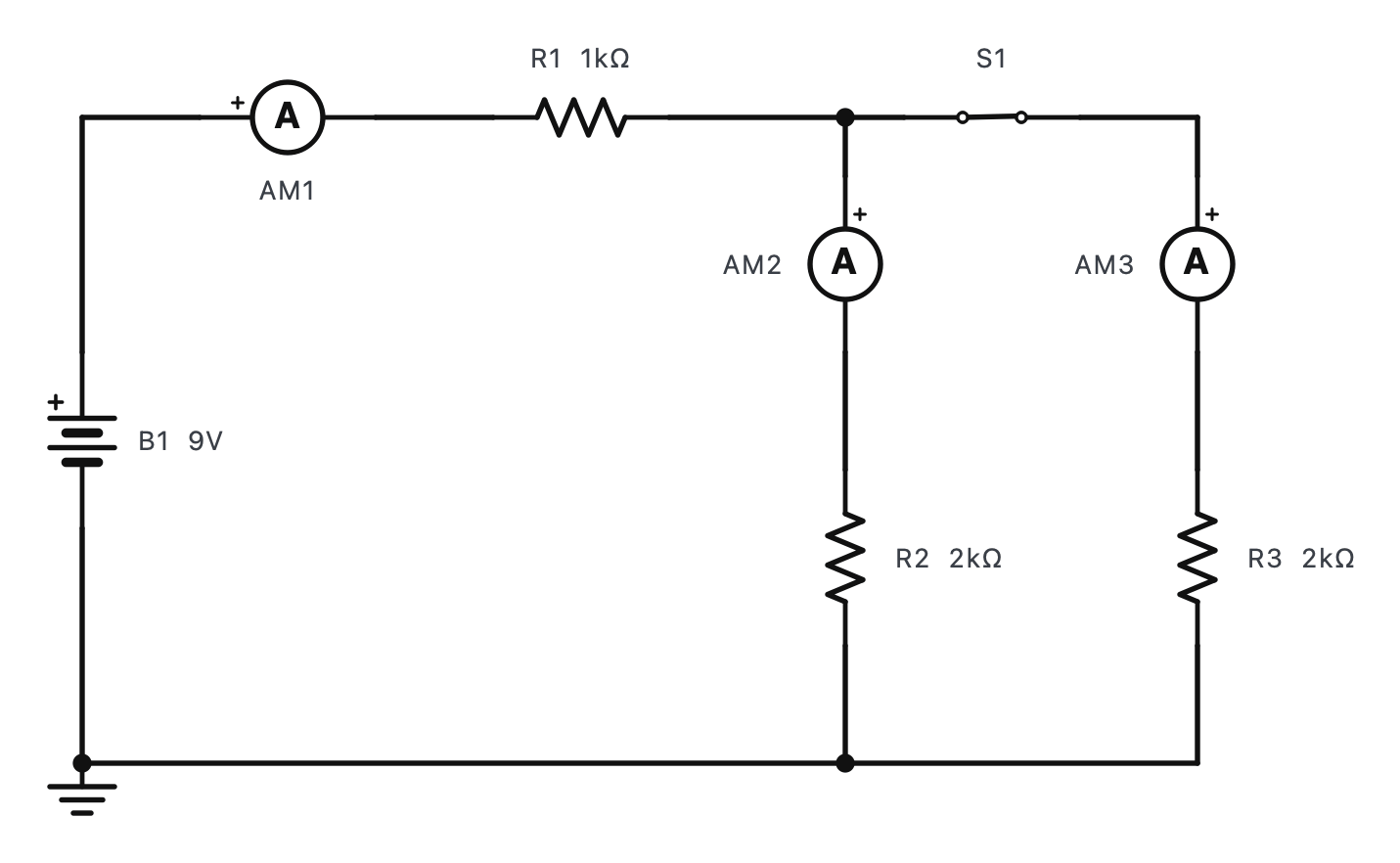
R1 (1 kΩ) feeds two 2 kΩ branches in parallel. Panel ammeters show the currents; you measure the voltages with the multimeter and watch both of Kirchhoff's laws hold as you change the circuit.
The steps
- Press RUN. Read the panel ammeters: AM1 about 4.5 mA in the main wire, AM2 and AM3 2.25 mA each. KCL: 2.25 + 2.25 = 4.5.Each ammeter shows its reading beside it while the circuit runs.
- Measure the voltage across R1 with the multimeter on V⎓ (red on R1's left end, black on its right end): 4.5 V.Across the part, one lead on each end.
- Move the leads across R2 (red on its top, black on its bottom): also 4.5 V. KVL: 4.5 + 4.5 = the battery's 9 V.Delete the two lead wires and wire them to R2's ends.
- Make R3 = 1k. The parallel pair falls to 667 Ω, so more current flows (AM1 about 5.4 mA), R1 takes more voltage and R2 less: about 3.6 V. AM3 now carries twice what AM2 does.Double-click R3 and type 1k. Current divider: the smaller resistor takes more.
- Click S1 to open it and take the R3 branch out. Now R1 and R2 are simply in series: 3 kΩ, 3 mA, and R2 gets 6 V. AM3 drops to zero and AM1 = AM2.A click on a switch flips it while the circuit runs.