
LessonSeries and parallel circuits · 15 min
Parallel circuits
Parts are in parallel when each one is connected across the same two points. Every socket in a house is in parallel with every other: each gets the full mains voltage, and switching one appliance off does not affect the others.
The three rules of a parallel circuit
- The same voltage is across every branch.
- Each branch current follows Ohm's law on its own: I = V / R.
- The currents add up: the supply provides the total.
- Rtotal
- the single resistance that would take the same total current - always smaller than the smallest branch
- R1 × R2 / (R1 + R2)
- "product over sum" - only for two at a time
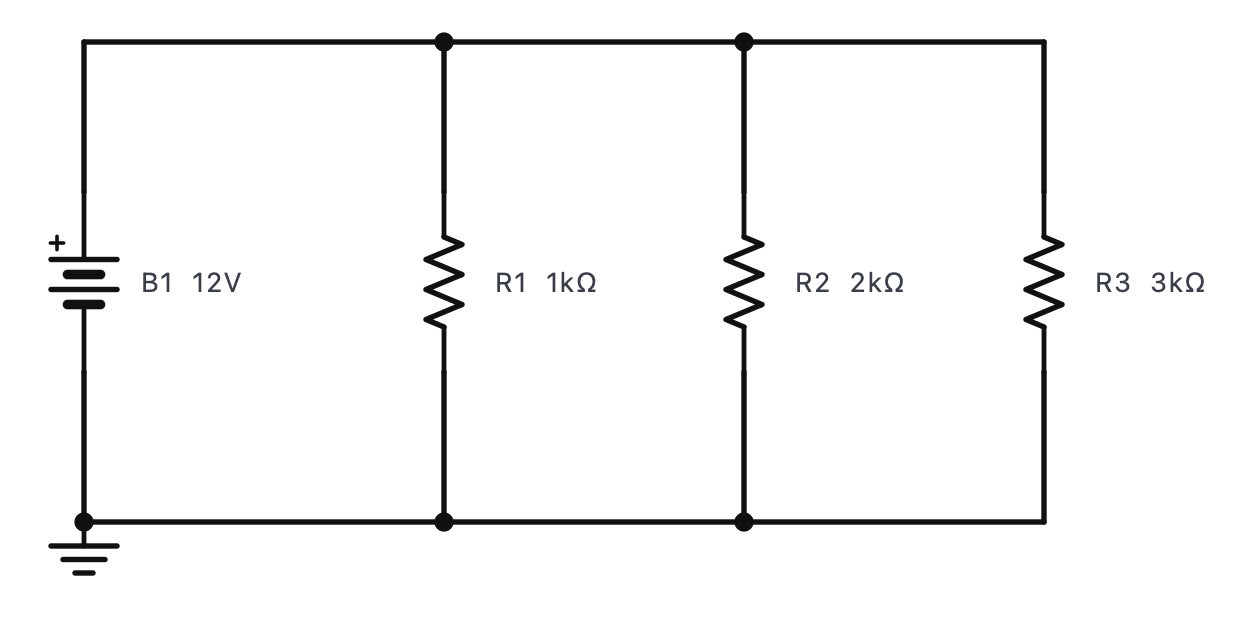
1 kΩ, 2 kΩ and 3 kΩ in parallel across 12 V. Find each current, the total and Rtotal.
- I1 = 12 / 1 k = 12 mA, I2 = 12 / 2 k = 6 mA, I3 = 12 / 3 k = 4 mA.
- Itotal = 12 + 6 + 4 = 22 mA.
- Rtotal = 12 V / 22 mA = 0.545 kΩ = 545 Ω.
- Check with the formula: 1 / (1/1 + 1/2 + 1/3) = 1 / 1.833 = 0.545 kΩ.
Answer: 12, 6 and 4 mA; 22 mA in all; 545 Ω - less than the smallest, 1 kΩ.
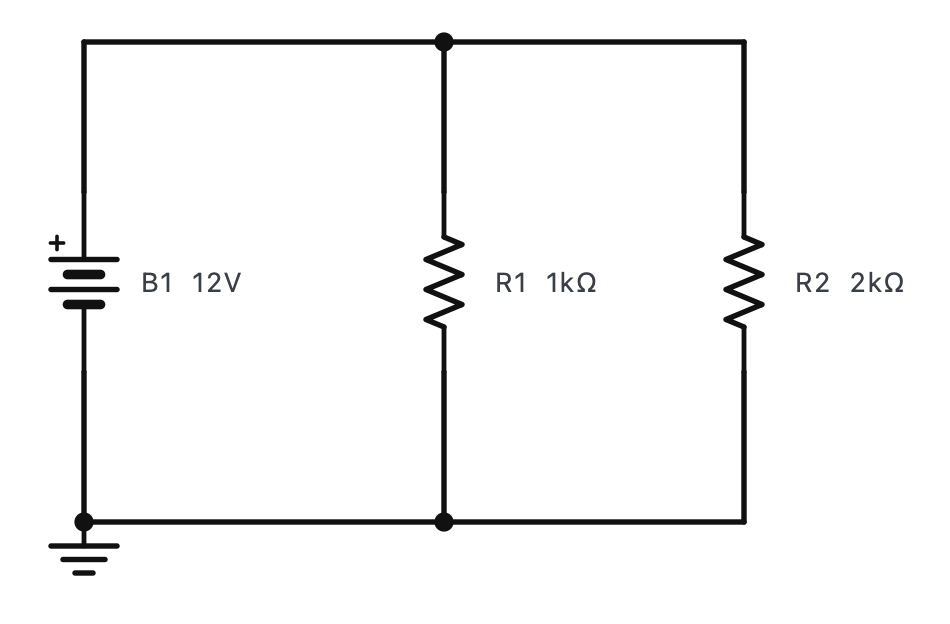
In parallel, adding a branch always lowers the total resistance - there is one more path for the current. However big R2 gets, the parallel pair never exceeds 1 kΩ.
Make R1 = R2: Rtotal is exactly half.
Where you meet it
Every socket and light is a branch across the 230 V mains.
In parallel, so one blown bulb does not take out the others.
Panels in parallel add their currents at the same voltage.
Two 100 Ω 1 W resistors in parallel make 50 Ω that can take 2 W.
Practice 1What is 10 kΩ in parallel with 10 kΩ?
Show the answer
Answer: 5000 Ω
Two equal resistors: R / 2 = 5 kΩ.
Practice 2What is 100 Ω in parallel with 220 Ω?
Hint
Product over sum.
Show the answer
Answer: 68.75 Ω
100 × 220 / 320 = 68.75 Ω.
Practice 3Three lamps take 0.5 A, 0.8 A and 1.2 A from a 12 V battery. What current does the battery supply?
Show the answer
Answer: 2.5 A
In parallel the currents add: 0.5 + 0.8 + 1.2 = 2.5 A.
Challenge 4What resistor must go in parallel with 1 kΩ to make 750 Ω?
Hint
1 / R = 1 / 750 − 1 / 1000.
Show the answer
Answer: 3000 Ω
1 / R = 0.001333 − 0.001 = 0.000333, so R = 3000 Ω (3 kΩ).
Challenge 5An extension board rated 13 A at 230 V already has a 1200 W microwave and a 150 W fridge on it. What is the most power (in W) you can still plug in?
Hint
The board's maximum power is 230 V × 13 A.
Show the answer
Answer: 1640 W
Maximum: 230 × 13 = 2990 W. Already used: 1350 W. Left: 1640 W - not enough for a 2000 W kettle.