
LessonPower and energy · 16 min
Energy: watt-hours, kWh and battery capacity
Power is how fast energy is used. Energy is how much: a 10 W light on for 10 hours uses as much as a 100 W TV on for 1 hour. Energy is what you pay for and what a battery stores.
- E
- the energy: in joules (J) if t is in seconds, in watt-hours (Wh) if t is in hours
- P
- the power (W)
- t
- the time
- 1 Wh = 1 W for one hour = 3600 J.
- 1 kWh = 1000 W for one hour = 3.6 million joules. This is the "unit" on an electricity meter - a prepaid meter's credit is counted in kWh.
A 100 W TV is on 5 hours a day for 30 days. How many kWh?
- E per day = 100 W × 5 h = 500 Wh = 0.5 kWh.
- E per month = 0.5 × 30 = 15 kWh.
Answer: 15 kWh (15 units on the meter).
Battery capacity: mAh and Wh
Batteries are rated in amp-hours (Ah) or milliamp-hours (mAh). That is really a charge: a 2000 mAh battery can deliver 2000 mA for 1 hour, or 200 mA for 10 hours. To get the energy, multiply by the voltage:
- V
- the battery's nominal voltage
- capacity
- its rating in Ah (mAh / 1000)
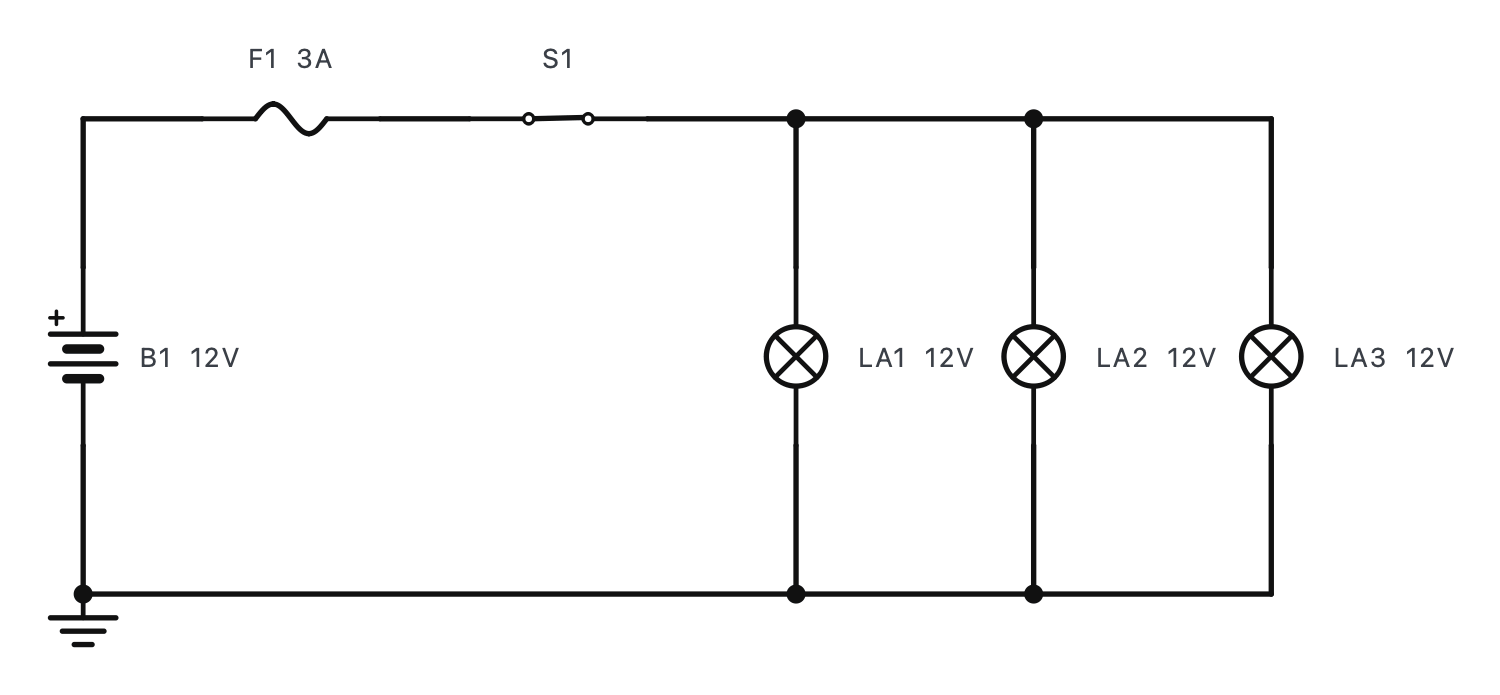
The three 5 W lamps above run from a 12 V 100 Ah lead-acid battery. A lead-acid battery should only be emptied to about half (50 % depth of discharge) to last for years. For how many hours can the lamps run?
- Stored energy: 12 V × 100 Ah = 1200 Wh.
- Usable at 50 %: 600 Wh.
- Load: 3 × 5 = 15 W.
- Runtime: 600 Wh / 15 W = 40 hours.
Answer: About 40 hours - roughly 8 nights at 5 hours a night (less in practice: wiring losses, an old battery, cloudy days).
Lithium (LiFePO4) batteries can use 80 - 90 %; lead-acid about 50 %.
Where you meet it
Size the panels and the battery from the Wh the house uses each day.
A sensor that sleeps at 50 µA and wakes for a moment can run for years on two AA cells: work out the average current, then the hours.
kWh × the price per unit. A 2000 W kettle for 6 minutes uses 0.2 kWh.
Practice 1A 9 W LED bulb is on for 6 hours. How much energy?
Hint
E = P × t.
Show the answer
Answer: 54 Wh
9 × 6 = 54 Wh.
Practice 2How long can a 2500 mAh battery supply 150 mA (ideal)?
Hint
hours = mAh / mA.
Show the answer
Answer: 16.67 h
2500 / 150 = 16.7 h.
Practice 3How much energy does a 12 V 7 Ah motorbike battery store?
Hint
Wh = V × Ah.
Show the answer
Answer: 84 Wh
12 × 7 = 84 Wh.
Challenge 4A power bank has 10 000 mAh of 3.7 V cells and converts to 5 V at 85 % efficiency. A phone battery holds 4000 mAh at 3.85 V. About how many full phone charges is that? (Ignore the phone's own charging losses.)
Hint
Compare energies in Wh, not mAh.
Show the answer
Answer: 2.04 charges
Power bank: 3.7 × 10 = 37 Wh, × 0.85 = 31.5 Wh delivered. Phone: 3.85 × 4 = 15.4 Wh. 31.5 / 15.4 = 2.04 charges - not the 2.5 that 10 000 / 4000 suggests.
Challenge 5A 2000 W kettle is used 3 times a day for 10 minutes each time. How many kWh does it use in 30 days?
Hint
Hours per day: 3 × 10 / 60.
Show the answer
Answer: 30 kWh
0.5 h a day × 2 kW = 1 kWh a day; × 30 = 30 kWh.