
PCB Designer · Inspect
EMC review and thermal analysis for your PCB - computed, not guessed
Catch the layout mistakes that fail EMC tests and the parts that run too hot while the board is still on screen. Impedance comes from a field solver and temperatures from a heat-flow simulation, both checked against exact solutions.
Windows 10 and 11 · macOS on Apple silicon · works offline after you sign in
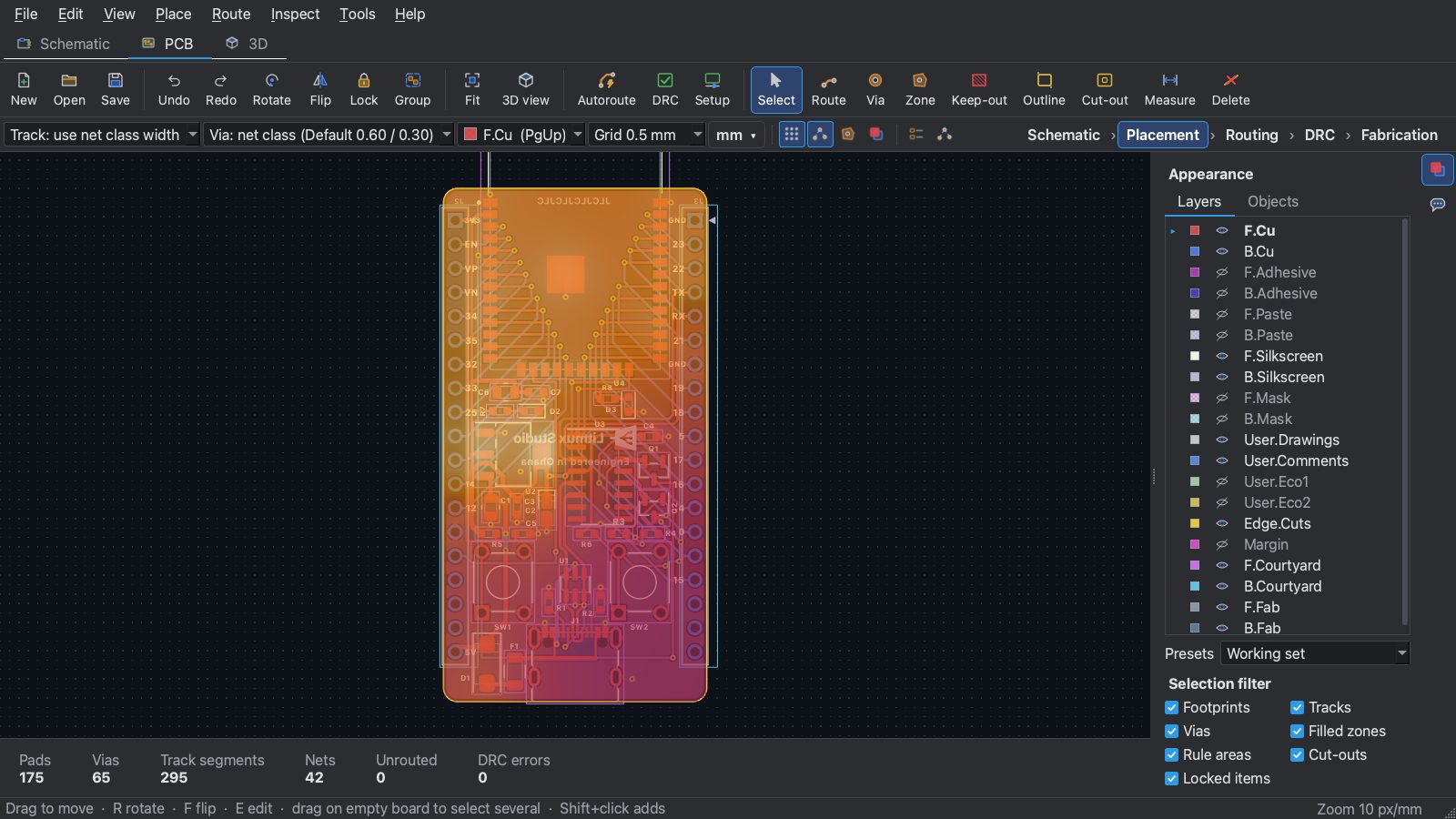
Field-solved impedance
Microstrip, stripline, coplanar and differential pairs solved with a 2D field solver that includes the solder mask - within 0.7 % of exact solutions in our tests.
Return paths
Every fast signal is followed over its reference plane: gaps, slots and layer changes under it are marked on the board.
Decoupling and power
Each chip's supply pins are matched with their capacitors and the distance to them; bulk capacitance and switching regulators are reviewed.
Edges, crystals, antennas, ESD
Fast nets near the board edge, crystal layout, antenna keep-outs, connectors without ESD protection and crosstalk between neighbours.
Heat flow from physics
Copper per cell, FR-4 through the thickness, vias, natural convection and radiation from both faces - solved until the heat in equals the heat out.
See the heat
A heat map in the dialog, laid over the board in the PCB Designer, or painted on the board in 3D, with each part's temperature and its margin to its limit.
An EMC review you can check
Open Inspect → EMC review and every finding comes with its reason and a marker where it is on the board. The review first decides what each net is - USB, a clock, RF, a switching node, a slow control line - and tells you why, so you can correct it when it guessed wrong. Distances such as the stitching pitch and the edge fence are worked out from the highest frequency on your board, not from a fixed rule of thumb.
- USB pairs checked against 90 Ω, other pairs against 100 Ω, with their real width, gap, the ground beside them and the solder mask
- Ground planes, return paths, decoupling, bulk capacitors and switching regulators
- Board edges, stitching, RF and antennas, ESD on connectors, crosstalk, crystals
It is a design review before compliance testing: it finds common layout causes of emission and immunity failures early. A test lab still gives the final answer for FCC or CE.
Thermal analysis with honest limits
Type each part's average power, choose how the board is cooled - lying flat, standing, or with a fan at a given air speed - and the air temperature (35 °C to start with, for hot rooms). The solver works out the copper in every cell of every layer, the heat through the FR-4 and the vias, and the cooling of each face by convection and radiation, until the energy balances.
- Checked in tests against exact solutions: a uniform board's energy balance and the FR-4 temperature drop exactly, a heated fin within 1.9 %, grid convergence within 2 %
- A junction temperature needs the part's ΨJB from its datasheet - without it the result says at least the board temperature instead of inventing a number
- It says what it leaves out - heat through cables, a battery, a screen or a case - so it errs warm
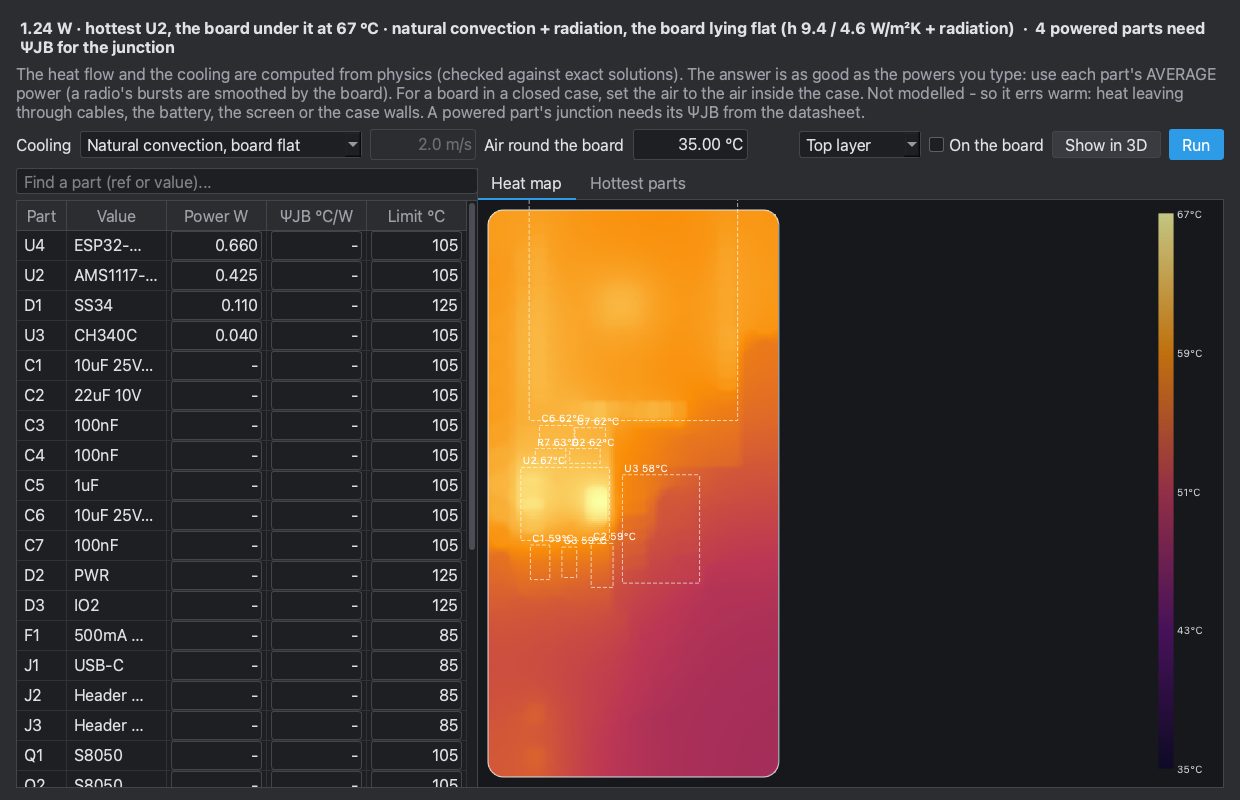
Part of the PCB Designer
Both analyses run on the board you are drawing in the PCB Designer - no export, no second tool. Fix a finding, run it again, and see the difference.
Questions
Does the EMC review replace an EMC test?
No. It is a pre-compliance design review: it finds the layout causes of common EMC failures before you build. Certification still needs a test lab.
How accurate is the impedance?
The 2D field solver agrees with exact solutions for microstrip and stripline to within 0.7 % in our tests. The result depends on the stack-up you enter - ask your factory for its real values.
How accurate is the thermal analysis?
The solver matches exact solutions in its tests (see above). The answer is as good as the powers you type: use each part's average power. Parts without a datasheet ΨJB show the board temperature under them as a lower bound.
Can I see the temperatures in 3D?
Yes: Show in 3D paints the board's faces by temperature with a colour scale in the 3D view.
More answers on the questions page.
More in Litmux Studio
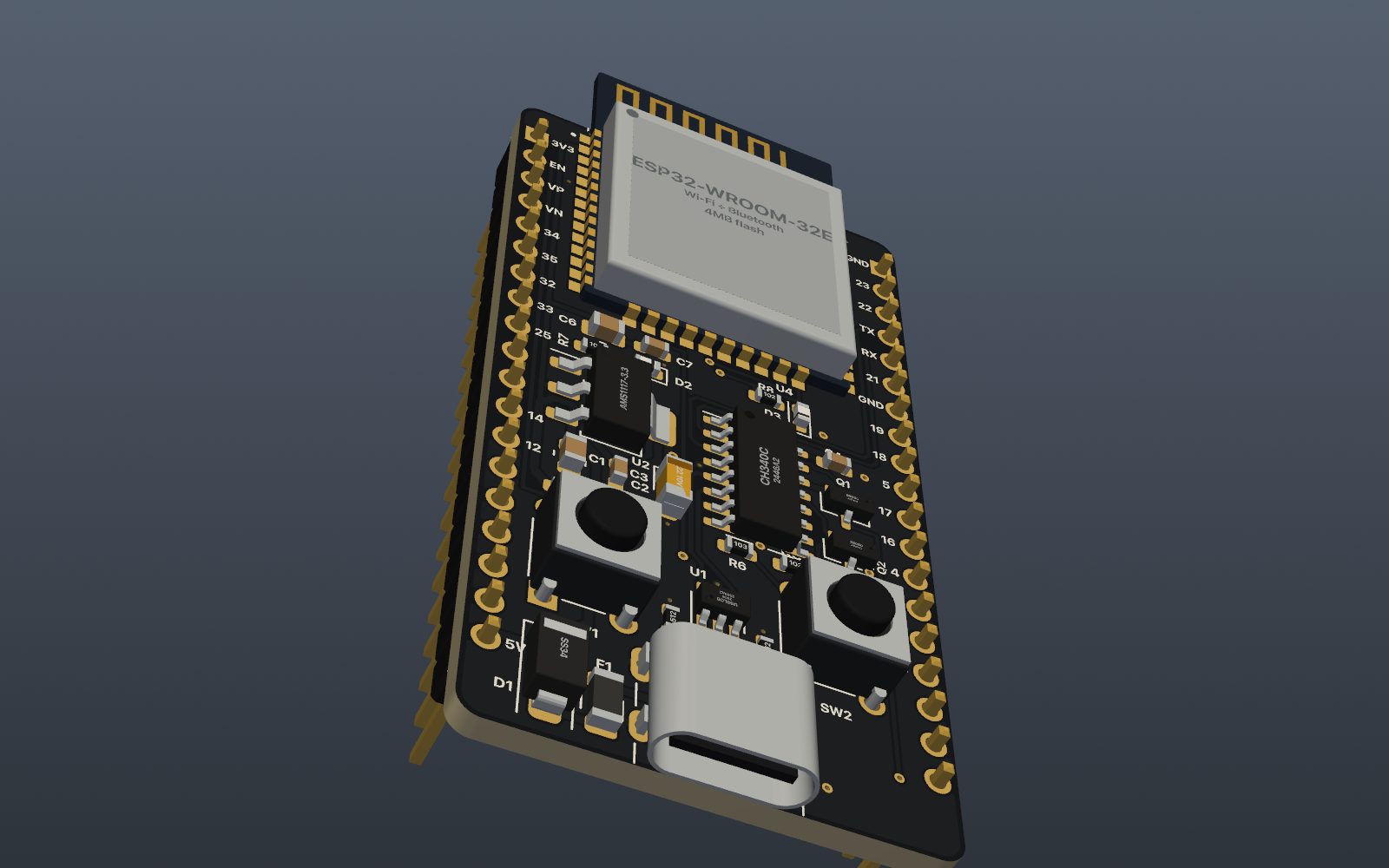 PCB designSchematic capture, PCB layout, autorouting, DRC and JLCPCB production files in one app, with 2,700+ parts
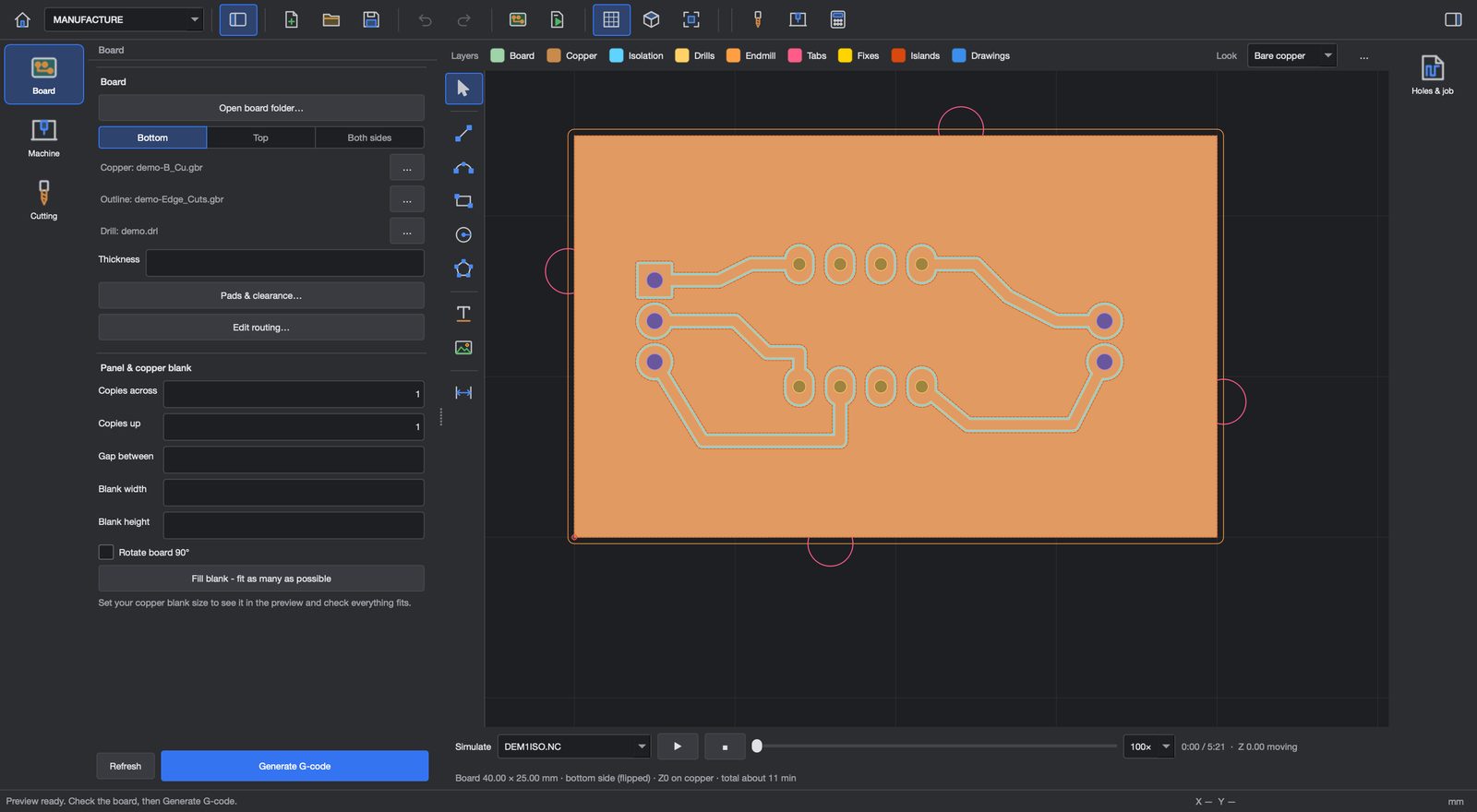 PCB millingTurn Gerber and drill files into G-code for your CNC router
 3D CADParametric 3D CAD with direct editing in the 3D view, assemblies, STEP, drawing sets, DXF for laser cutting and photo-real renders
Try every app free for 7 days
Download Litmux Studio, create your account and every app opens on that computer - no payment needed. Plans for students, makers, professionals and schools when you are ready.