
LessonPower sources and safety · 15 min
Electrical safety: shock, fire and batteries
Electricity is safe to work with when you understand what actually causes harm. There are two separate dangers: current through your body (shock), and energy released where it should not be (heat, fire, burns, exploding batteries).
Shock: it is the current that harms
| Current through the body (50 Hz AC) | Typical effect |
|---|---|
| about 1 mA | Just felt as a tingle |
| about 10 mA | Painful; muscles clench - you may not be able to let go |
| about 30 mA | Breathing difficult - the trip level of a household RCD |
| 50 - 100 mA and up | Can stop the heart (ventricular fibrillation) |
Voltage matters because it drives that current through your body's resistance: Ohm's law again. Dry skin can be 100 kΩ or more; wet or broken skin around 1 kΩ. The worst path is hand to hand or hand to foot, across the chest.
Compare 12 V across dry skin (100 kΩ) with 230 V across wet skin (1 kΩ).
- 12 V / 100 kΩ = 0.12 mA - not even felt.
- 230 V / 1 kΩ = 230 mA - easily fatal.
Answer: Extra-low voltages (under about 50 V AC or 120 V DC) are not normally a shock risk. The 230 V 50 Hz mains always is.
Energy: shorts, heat and fire
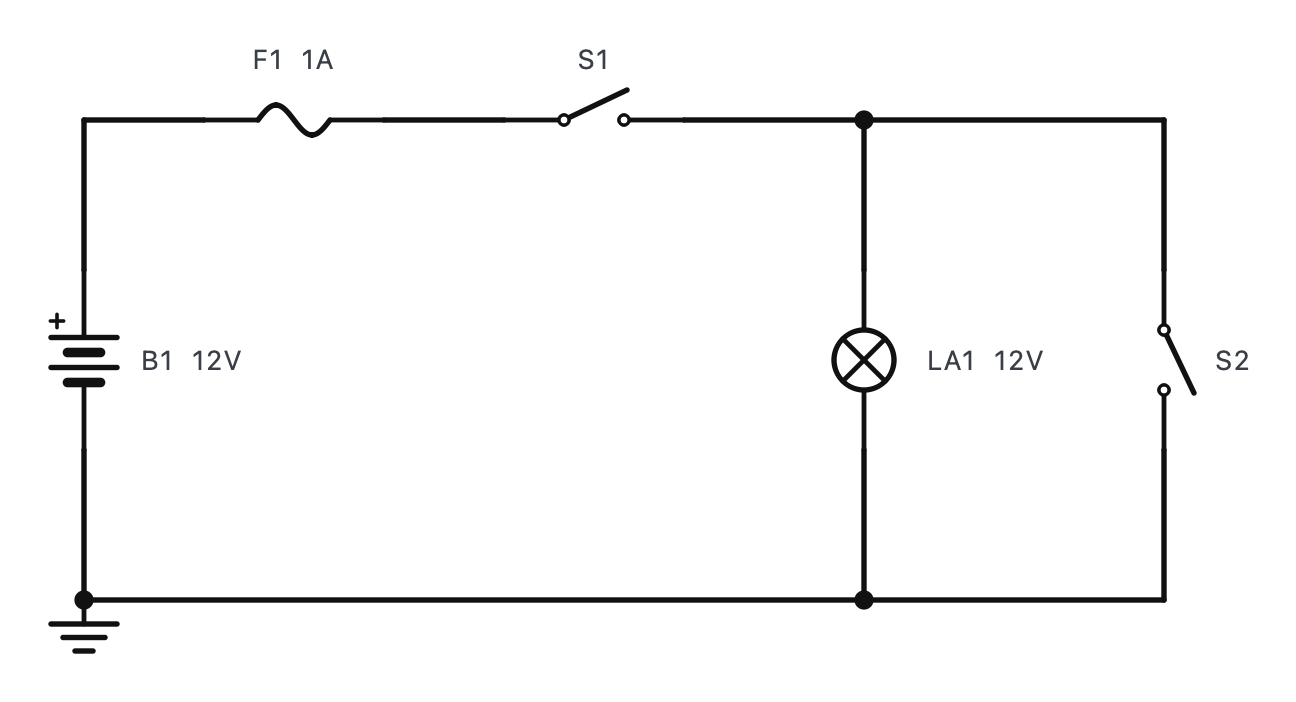
A 12 V battery cannot shock you - but shorted, it can deliver hundreds of amps. Wires glow, insulation burns, rings and watch straps weld to terminals. Protection devices exist for each danger:
| Device | What it protects | How |
|---|---|---|
| Fuse | The wiring (from overheating) | A thin link melts above its rated current |
| Circuit breaker (MCB) | The wiring | Trips on overcurrent; can be reset |
| RCD / RCCB (30 mA) | PEOPLE | Trips when current leaks to earth - for example through a person - instead of returning on the neutral |
| Earth wire | People | Gives a fault current a safe path so the breaker trips |
Batteries and capacitors
- Lithium cells: crushed, punctured, over-charged or shorted, they can go into thermal runaway - fire that is hard to put out. Never charge a swollen cell; charge with the right charger and a BMS.
- Lead-acid batteries give off hydrogen while charging: ventilate, no sparks nearby. Their acid burns skin and eyes.
- Capacitors in mains power supplies (phone chargers, TVs, microwave ovens) can hold a dangerous charge after unplugging. Leave them to experts, or discharge through a resistor.
Working habits that keep you safe
- Power off and disconnect before changing a circuit; reconnect only when you are done.
- Use a current-limited supply for new circuits.
- Fuse every battery output, close to the battery.
- Remove rings and watches when working on batteries.
- Keep one hand away (in a pocket) when probing anything above extra-low voltage.
- Test before you touch: check your meter on a known source, then on the circuit, then on the known source again.
Practice 1What current flows through a body of 2 kΩ touching 230 V?
Show the answer
Answer: 115 mA
230 / 2000 = 0.115 A = 115 mA - in the danger zone.
Practice 2Which device protects a PERSON from an electric shock?
- A fuse
- A circuit breaker
- An RCD (30 mA)
- A thicker cable
Show the answer
Answer: C. An RCD (30 mA)
The RCD trips at around 30 mA of leakage - far below the current that blows a fuse.
Practice 3A fuse keeps blowing in a solar lighting circuit. The right action is:
- Fit a bigger fuse
- Bridge it with wire
- Find and fix the fault that draws too much current
- Remove it
Show the answer
Answer: C. Find and fix the fault that draws too much current
The fuse is doing its job: something is wrong.
Challenge 4Four 12 V 10 W lamps run from a 12 V battery through cable rated 5 A. Which fuse is right?
- 2 A
- 5 A
- 7.5 A
- 15 A
Hint
Work out the current, then choose above it but not above the cable's rating.
Show the answer
Answer: B. 5 A
40 W / 12 V = 3.3 A. A 5 A fuse is above the normal current and does not exceed the cable's 5 A. 2 A would blow at once; 7.5 A and 15 A would let the cable overheat.