
LessonWhat electricity is · 15 min
Resistance, open circuits and short circuits
The same battery pushes a tiny current through a long thin wire and a huge one through a short thick bar. What sets the difference is resistance: how strongly a path opposes current. It is measured in ohms (Ω).
What makes resistance
Free electrons moving through a metal keep bumping into the vibrating atoms, losing energy as heat. More bumping means more resistance. Four things set it:
- Material - its resistivity ρ (rho). Copper: 1.68 × 10⁻⁸ Ω·m. Nichrome, made for heaters: 1.1 × 10⁻⁶ Ω·m, about 65 times higher.
- Length - twice as long, twice the resistance (twice as many collisions).
- Cross-section area - twice as thick, half the resistance (twice as many paths side by side).
- Temperature - metals resist more when hot (a lamp filament is about 10× higher hot than cold).
- R
- resistance (Ω)
- ρ
- resistivity of the material (Ω·m)
- L
- length (m)
- A
- cross-section area (m²); 1 mm² = 1 × 10⁻⁶ m²
What is the resistance of 10 m of 1.5 mm² copper wire (common house wiring for lights)?
- A = 1.5 mm² = 1.5 × 10⁻⁶ m².
- R = 1.68 × 10−8 × 10 / 1.5 × 10⁻⁶.
- R = 0.112 Ω.
Answer: 0.112 Ω - tiny, but not zero. A current must go there AND back, so a 10 m run has 20 m of wire in the loop: 0.224 Ω. You will see in the next section why that matters for solar systems.
Resistors: resistance on purpose
A resistor is a part made to have a known resistance - 220 Ω, 10 kΩ (10 000 Ω), 1 MΩ (1 000 000 Ω). Resistors limit current (so an LED does not burn), set voltages (the voltage divider) and turn current into a voltage that a microcontroller can read. They are the most common part on any circuit board.
Open circuits and short circuits
An open circuit is a break in the loop: a switch that is off, a broken wire, a blown fuse, a cracked solder joint. Its resistance is (almost) infinite and no current flows anywhere in that loop.
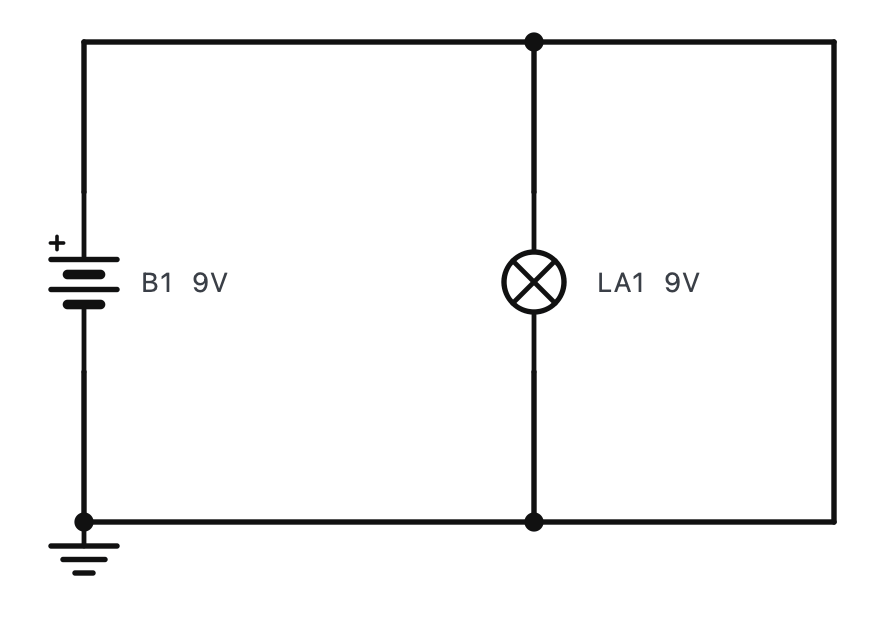
A short circuit is the opposite: a path of (almost) zero resistance where there should not be one, so the current takes the easy path. With nothing to limit it, the current becomes enormous - only the battery's own resistance and the wires hold it back. Wires overheat, insulation melts, batteries can burst.
Where you meet it
Long runs (solar panels on the roof, a borehole pump at the end of the garden) need thicker cable so the wire's resistance stays small.
Kettles, irons and water heaters use high-resistance nichrome wire so the current turns into heat.
"Nothing works" is usually an open circuit (a broken wire, a blown fuse); "it blew the fuse" is usually a short.
Practice 1What is the resistance of 100 m of 2.5 mm² copper cable?
Hint
R = ρ L / A with ρ = 1.68 × 10⁻⁸ Ω·m and A = 2.5 × 10⁻⁶ m².
Show the answer
Answer: 0.672 Ω
R = 1.68 × 10−8 × 100 / 2.5 × 10−6 = 0.672 Ω.
Practice 2You double a wire's length AND double its cross-section area. Its resistance:
- doubles
- halves
- stays the same
- becomes four times bigger
Show the answer
Answer: C. stays the same
Double the length doubles R, double the area halves it: the two cancel.
Practice 3A torch does not light. The bulb is good and the battery is new. The most likely fault is:
- A short circuit
- An open circuit - a bad contact or a broken wire
- Too much current
- The resistance is too low
Show the answer
Answer: B. An open circuit - a bad contact or a broken wire
Nothing flows: the loop is broken somewhere. A short would usually flatten the battery or make it hot.
Challenge 410 m of 1.5 mm² copper has a resistance of 0.112 Ω. Without using ρ, what is the resistance of 25 m of 2.5 mm² copper?
Hint
Scale by the length ratio, then by the inverse of the area ratio.
Show the answer
Answer: 0.168 Ω
Length × 2.5 → 0.28 Ω. Area × (2.5 / 1.5) → divide by 1.667: 0.28 / 1.667 = 0.168 Ω.