
LessonThe voltage divider · 17 min
The loading effect - and why a divider is not a power supply
The divider formula assumes nothing else draws current from the middle point. Connect something that does - a load - and the output voltage drops. Understanding this loading effect is what separates a divider that works from one that mysteriously reads low.
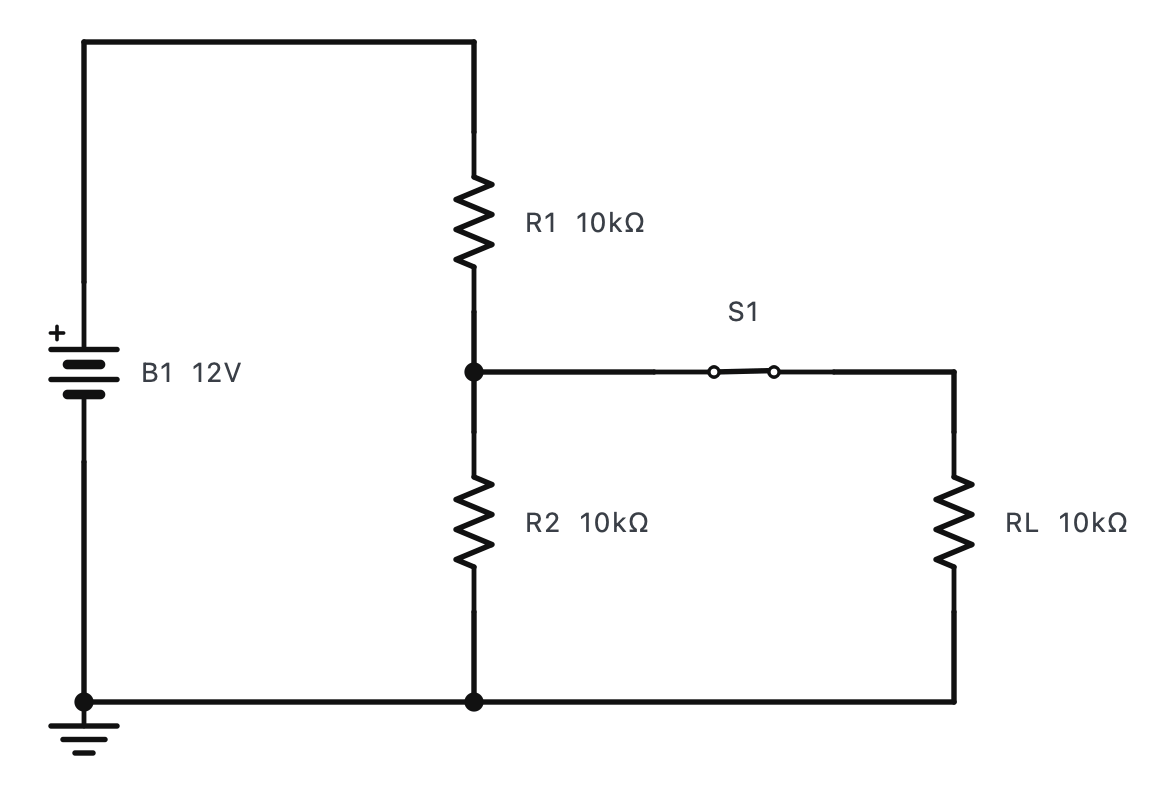
The divider above has a 10 kΩ load across R2. What is Vout?
- R2 ∥ RL = 10 k ∥ 10 k = 5 kΩ.
- Vout = 12 × 5 / (10 + 5) = 4.0 V.
- The load's current also flows through R1, making R1's share bigger.
Answer: 4.0 V instead of 6 V - a third lower.
A divider looks like a weak battery
Seen from its output, any divider behaves exactly like a battery of its unloaded voltage in series with a resistance R1 ∥ R2 (this is Thévenin's theorem, which you will use a lot later):
- Vth
- the unloaded output, Vin × R2 / (R1 + R2)
- Rth
- the divider's output resistance, R1 ∥ R2 = R1 R2 / (R1 + R2)
- RL
- the load's resistance
For the example: Vth = 6 V, Rth = 5 kΩ, so Vloaded = 6 × 10 / 15 = 4 V - the same answer, and now you can see why. The load must be much bigger than Rth for the divider to hold its voltage:
| Load RL | Output falls by |
|---|---|
| = Rth | 50 % |
| 10 × Rth | 9 % |
| 100 × Rth | 1 % |
| 1000 × Rth | 0.1 % |
Make R1 and R2 ten times smaller: the drop shrinks, but the divider's current grows ten times.
Your meter is a load too
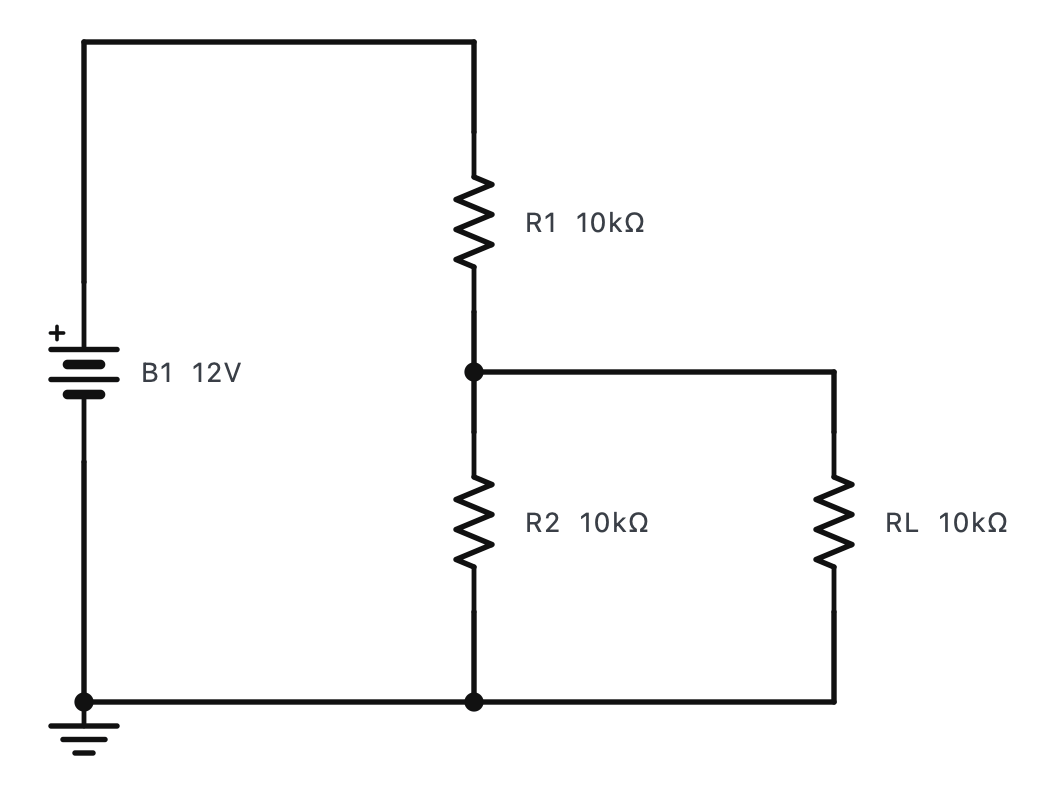
A digital multimeter on volts has about 10 MΩ inside. On a 1 MΩ / 1 MΩ divider across 10 V (Rth = 500 kΩ) it reads 5 × 10 / 10.5 = 4.76 V, not 5 V. When a reading of a high-resistance circuit looks a little low, suspect the meter's own loading.
Choosing the values
| Values | Good | Bad |
|---|---|---|
| Small (100 Ω - 1 kΩ) | Stiff: loads hardly move it; fast; low noise | Wastes current and power; drains batteries |
| Medium (10 kΩ - 100 kΩ) | The usual choice for ADC inputs and logic signals | Check the load is ≥ 10× R1 ∥ R2 |
| Large (1 MΩ and up) | Microamps: fine for always-on battery monitors | Sensitive to loads, leakage and noise; an ADC may need a capacitor at its pin |
A 10 k / 10 k divider stays connected to a 12 V battery all the time. How much charge does it use per day? And with 1 M / 1 M?
- 10 k + 10 k: I = 12 / 20 k = 0.6 mA → 0.6 × 24 = 14.4 mAh a day.
- 1 M + 1 M: I = 6 µA → 0.144 mAh a day.
Answer: 14.4 mAh/day is nothing for a 100 Ah solar battery but would flatten a 220 mAh coin cell in two weeks. Match the values to the battery.
Why a divider is not a power supply
A 5 V motor drawing 100 mA looks like 50 Ω. Make "5 V" from 12 V with 140 Ω / 100 Ω and connect it: R2 ∥ 50 Ω = 33 Ω, so the motor gets 12 × 33 / 173 = 2.3 V. It barely turns, the voltage swings as its current changes, and R1 burns 0.7 W as heat. Any load that takes real current - a motor, an LED strip, a module, a phone - needs a regulator (a 7805 or LM317, or a switching buck converter), never a divider.
Practice 1What is the output resistance of a 22 k / 10 k divider?
Show the answer
Answer: 6875 Ω
22 × 10 / 32 = 6.875 kΩ.
Practice 2A 10 V, 10 k / 10 k divider feeds a 100 kΩ load. What is Vout?
Hint
Vth = 5 V, Rth = 5 kΩ.
Show the answer
Answer: 4.762 V
5 × 100 / 105 = 4.76 V (a 4.8 % drop).
Practice 3Which divider holds 2.5 V from 5 V best when a 10 kΩ load is connected?
- 1 MΩ / 1 MΩ
- 100 kΩ / 100 kΩ
- 1 kΩ / 1 kΩ
- They are all the same
Show the answer
Answer: C. 1 kΩ / 1 kΩ
1 k / 1 k has Rth = 500 Ω, twenty times smaller than the load: the output drops only about 5 %. The others collapse.
Challenge 4A 12 V, 10 k / 10 k divider is measured with a meter of 1 MΩ input resistance (a cheap analogue meter). What does it read?
Hint
Vth = 6 V, Rth = 5 kΩ, RL = 1 MΩ.
Show the answer
Answer: 5.97 V
6 × 1000 / 1005 = 5.97 V - only 0.5 % low, because the divider's Rth is small.
Challenge 5Design a divider giving 3.0 V (unloaded) from 9 V whose output falls by no more than 1 % into a 100 kΩ load. What is the largest R1 you can use? (R2 = R1 / 2.)
Hint
1 % drop needs Rth ≤ RL / 99. And Rth = R1 ∥ (R1/2) = R1 / 3.
Show the answer
Answer: 3030 Ω
Rth ≤ 100 k / 99 = 1.01 kΩ. Rth = R1 / 3, so R1 ≤ 3.03 kΩ: use R1 = 3 kΩ (or 2.7 k) and R2 = 1.5 kΩ.