
LessonPower sources and safety · 16 min
Cells and batteries: voltage, capacity and packs
A cell is one chemical unit that makes a voltage; a battery is strictly several cells together (a "9 V battery" is six 1.5 V cells). Each chemistry has its own voltage, and that voltage is what decides how cells are combined into packs.
| Chemistry | Cell voltage | Rechargeable? | Where you meet it |
|---|---|---|---|
| Alkaline | 1.5 V (falls to about 1.0 V when flat) | No | Remotes, clocks, torches |
| NiMH | 1.2 V | Yes | Rechargeable AA / AAA |
| Lithium-ion / LiPo | 3.6 - 3.7 V nominal: 4.2 V full, about 3.0 V empty | Yes | Phones, power banks, laptops, 18650 cells, drones |
| LiFePO4 (lithium iron phosphate) | 3.2 V nominal (3.65 V full) | Yes | Solar storage, e-bikes; long life and safer |
| Lead-acid | 2.0 V per cell; a "12 V" battery has 6 cells: 12.7 V full | Yes | Cars, motorbikes, UPS units, solar systems |
| Lithium coin cell (CR2032) | 3.0 V, about 220 mAh | No | Watches, key fobs, RTC backup |
Capacity and C-rate
Capacity (Ah or mAh) is the charge a battery can deliver from full to empty. Battery makers also speak of the C-rate: 1C is the current that would empty it in one hour. For a 2000 mAh cell, 1C = 2 A, 0.5C = 1 A, 2C = 4 A. High currents give less usable capacity (especially from lead-acid) and heat the cells.
Cells in series and in parallel
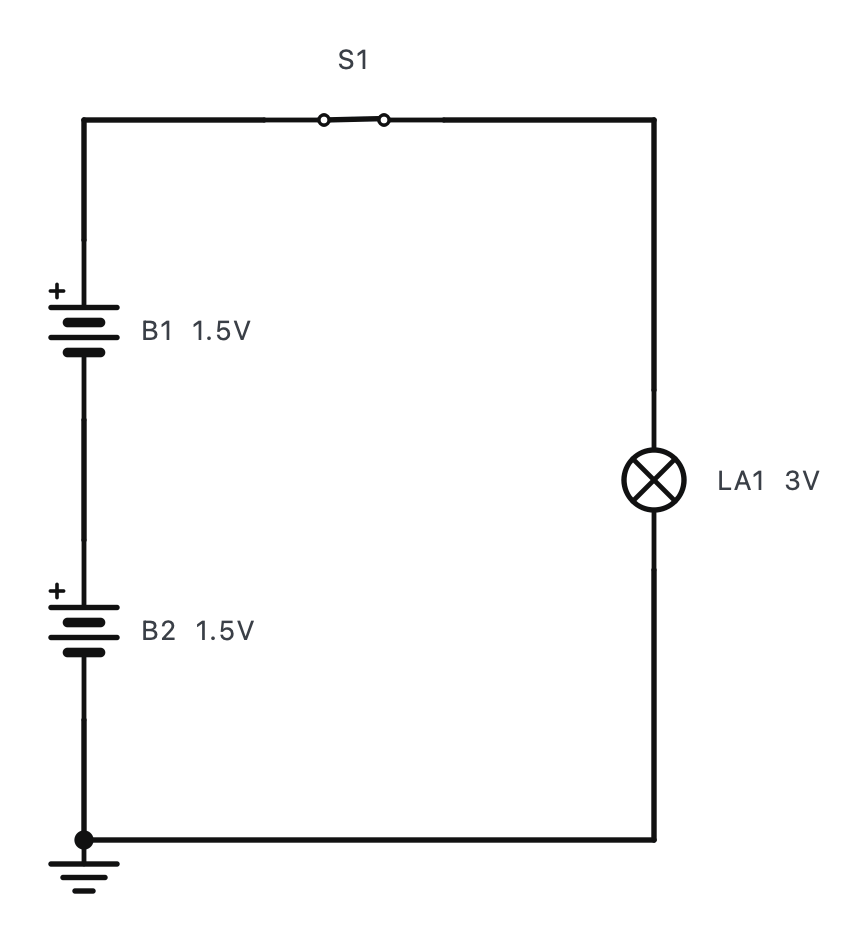
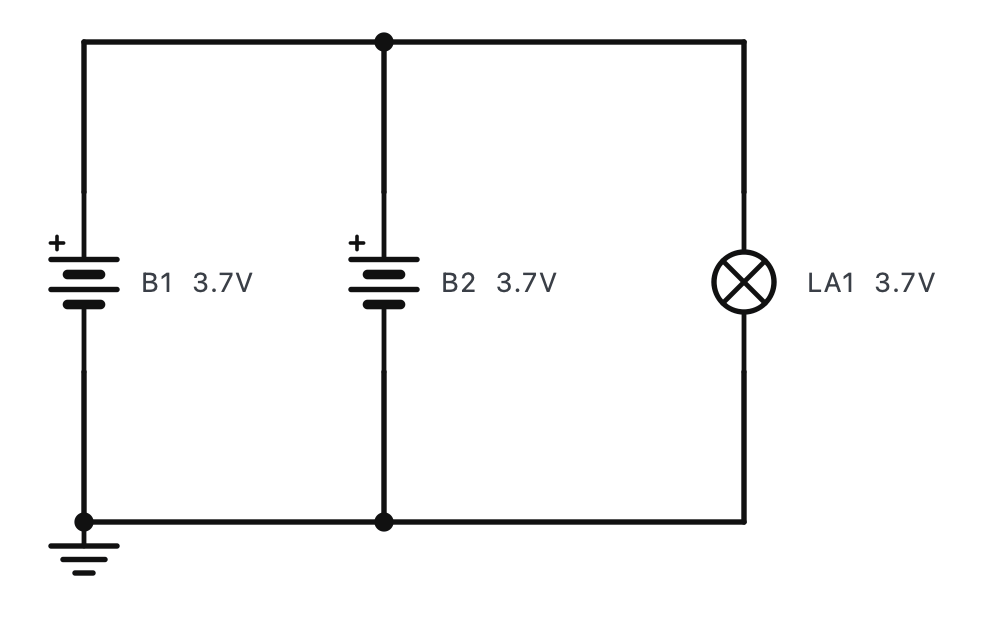
- n S m P
- how packs are described: "3S2P" = 3 in series, 2 such strings in parallel
- Energy
- Wh = V × Ah of the whole pack = number of cells × Wh of one cell
Four 18650 cells (3.7 V, 2500 mAh) are built into a 2S2P pack. Voltage, capacity and energy?
- 2S: 2 × 3.7 = 7.4 V.
- 2P: 2 × 2500 = 5000 mAh.
- Energy: 7.4 V × 5 Ah = 37 Wh (= 4 × 9.25 Wh).
Answer: 7.4 V, 5000 mAh, 37 Wh.
| 12 V lead-acid at rest | State of charge (roughly) |
|---|---|
| 12.7 V | 100 % |
| 12.4 V | 75 % |
| 12.2 V | 50 % |
| 12.0 V | 25 % |
| 11.9 V or less | empty - recharge now, or the battery is damaged |
Where you meet it
12 V or 24 V lead-acid or LiFePO4 banks: series for voltage, parallel for capacity.
Several 3.7 V cells in parallel (1S3P...), boosted to 5 V for USB.
Long series strings: a 36 V e-bike pack is 10S, a 48 V pack 13S.
Two 12 V batteries in series make 24 V.
Practice 1How many lead-acid cells (2 V each) are in a 24 V battery bank?
Show the answer
Answer: 12 cells
24 / 2 = 12 cells in series.
Practice 2What is 1C for a 3000 mAh cell?
Show the answer
Answer: 3 A
The current that empties it in 1 hour: 3000 mA = 3 A.
Practice 3Two 12 V 100 Ah batteries are connected in parallel. The bank is:
- 24 V 100 Ah
- 12 V 200 Ah
- 24 V 200 Ah
- 12 V 100 Ah
Show the answer
Answer: B. 12 V 200 Ah
Parallel: the voltage stays, the capacity adds.
Challenge 4A 48 V e-bike pack is 13S4P of 3.6 V 3000 mAh cells. How much energy does it store, in Wh?
Hint
Voltage = 13 × 3.6 V; capacity = 4 × 3 Ah.
Show the answer
Answer: 561.6 Wh
46.8 V × 12 Ah = 561.6 Wh (= 52 cells × 10.8 Wh).