
LessonSeries and parallel circuits · 15 min
Kirchhoff's laws: current at a junction, voltage round a loop
Series and parallel rules are special cases of two general laws, written down by Gustav Kirchhoff in 1845. They hold in every circuit, however tangled, and they are how engineers check a design - and a measurement.
Kirchhoff's current law (KCL)
- Σ
- "the sum of"
- junction
- a node: any point where wires meet
Charge cannot pile up in a wire or vanish from it, so whatever current flows into a junction must flow out again. 13.5 mA arriving at a split can become 9 mA + 4.5 mA - never anything else.
Kirchhoff's voltage law (KVL)
- rises
- going through a source from − to +
- drops
- going through a part in the direction of the current
Each coulomb gains energy in the battery and gives it all away on its trip round the loop - it comes back to where it started with nothing extra. Think of a walk over a hill that ends where it began: all the climbs equal all the descents.
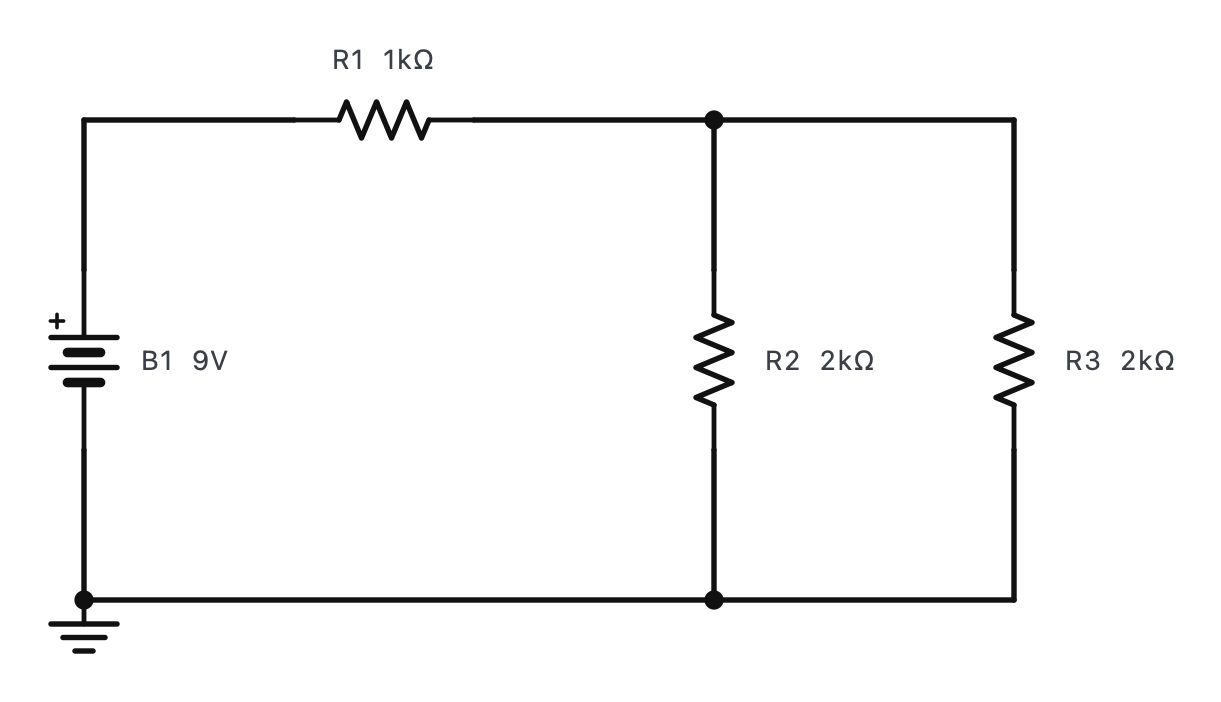
Find all the currents and voltages in the circuit above.
- R2 ∥ R3 = 2 k / 2 = 1 kΩ, so the battery sees 1 k + 1 k = 2 kΩ.
- I = 9 V / 2 kΩ = 4.5 mA - this flows through R1.
- VR1 = 4.5 mA × 1 kΩ = 4.5 V.
- KVL round the loop B1 → R1 → R2: 9 = 4.5 + VR2, so VR2 = 4.5 V (and VR3 = 4.5 V: it is in parallel).
- I2 = 4.5 V / 2 kΩ = 2.25 mA, I3 = 2.25 mA.
- KCL at the junction below R1: 4.5 mA in = 2.25 + 2.25 mA out. ✓
Answer: 4.5 mA in R1; 2.25 mA in each of R2 and R3; 4.5 V across R1 and 4.5 V across R2 ∥ R3.
Where you meet it
Measure the voltage across each part in a loop: they must add up to the supply. Where the "missing" voltage sits, there is a bad joint or a broken wire.
The current from a battery is the sum of every load's current (KCL) - add them up to choose the fuse, the cable and the battery.
If KCL or KVL fails, a reading or a connection is wrong.
Practice 1Into a junction flow 20 mA and 35 mA. One wire leaves carrying 40 mA. What does the other leaving wire carry?
Show the answer
Answer: 15 mA
In: 55 mA. Out: 40 + I. So I = 15 mA.
Practice 2A 12 V battery drives a loop of three parts. Two have 3 V and 5 V across them. What is across the third?
Show the answer
Answer: 4 V
KVL: 12 = 3 + 5 + V, so V = 4 V.
Practice 3Measured to 0 V, the top of a resistor is at 7.2 V and its bottom at 2.7 V. The voltage across it is:
Show the answer
Answer: 4.5 V
7.2 − 2.7 = 4.5 V.
Challenge 412 V; R1 = 2 kΩ in series with R2 = 3 kΩ ∥ R3 = 6 kΩ. What current flows in R3?
Hint
R2 ∥ R3 first, then the total current, then the voltage across the parallel pair.
Show the answer
Answer: 1 mA
R2 ∥ R3 = 3 × 6 / 9 = 2 kΩ. I = 12 / 4 k = 3 mA. V across the pair = 3 mA × 2 k = 6 V (KVL: R1 takes the other 6 V). I3 = 6 / 6 k = 1 mA (and I2 = 2 mA: 1 + 2 = 3 ✓).