
LessonUsing a multimeter · 14 min
Meet the multimeter
A multimeter is the electronics engineer's first and most-used instrument: a voltmeter, an ammeter and an ohmmeter in one box. Used well, it answers nearly every "why does this not work?". Used badly, it blows its fuse - or misleads you. Electronics Studio's multimeter behaves like a real one, so the habits you build here carry straight over.
Its parts
- The display: the reading, with its unit and a minus sign when the leads are the other way round. "OL" means overload - more than the range can show (or an open circuit on Ω).
- The dial: what it measures. V⎓ (DC volts), V~ (AC volts), A⎓ / A~ (current), Ω (resistance, often with the continuity beeper and diode test on the same position).
- The sockets: COM - the black lead, always. VΩ - the red lead for volts, ohms and continuity. 10A (and often a separate mA) - the red lead for current only.
| To measure | Dial | Red lead in | Connect the meter | The circuit |
|---|---|---|---|---|
| Voltage | V⎓ or V~ | VΩ | ACROSS the part (in parallel) | powered |
| Current | A⎓ or A~ | 10A (or mA) | IN the loop (in series) - open it first | powered |
| Resistance | Ω | VΩ | across the part, out of the circuit | OFF |
| Continuity | Ω / beeper | VΩ | across the wire, fuse or switch | OFF |
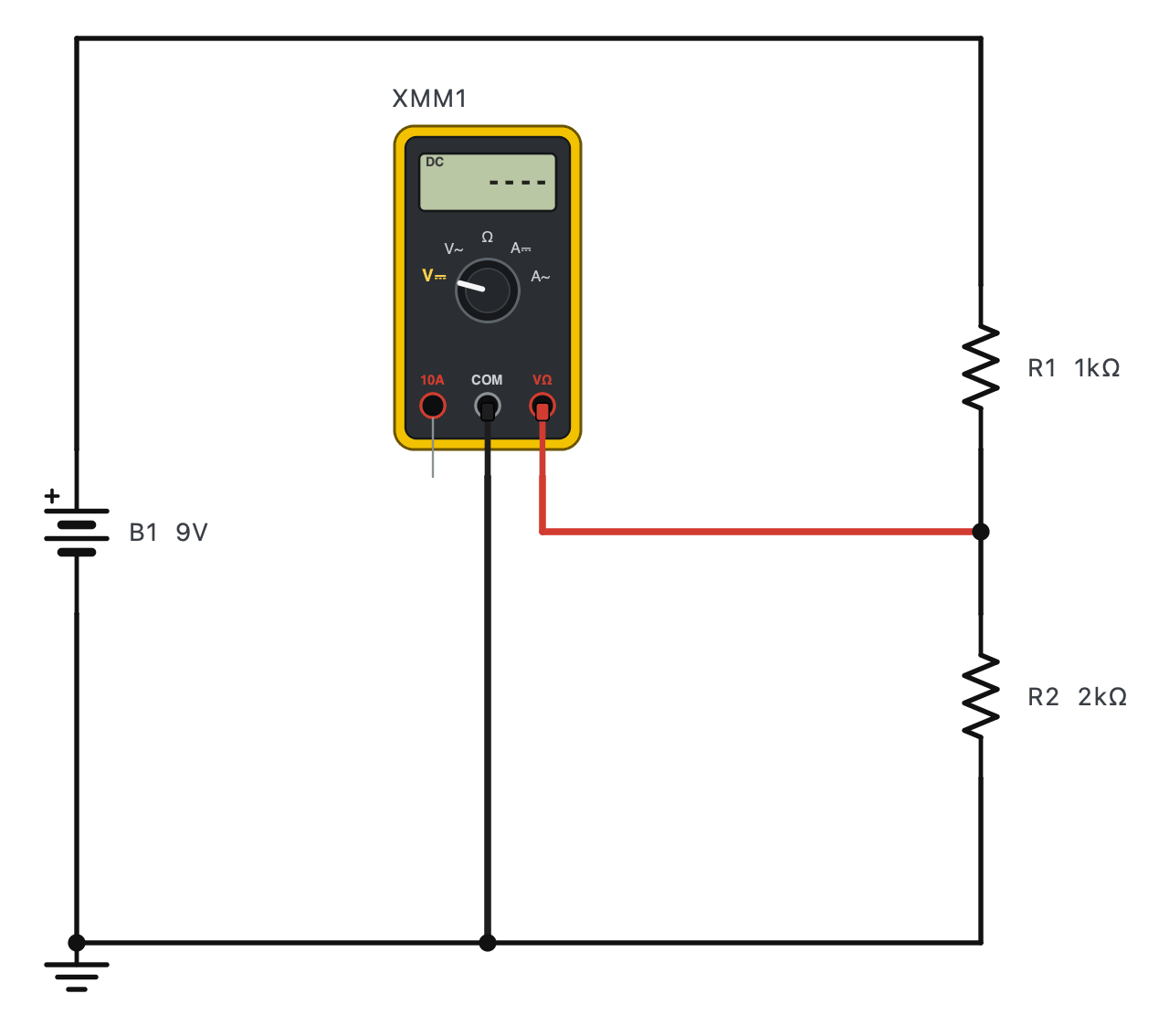
What is inside each mode
- Volts: a very high resistance (about 10 MΩ) between VΩ and COM. It takes almost no current, so it can be connected across anything without disturbing it much.
- Amps: a tiny resistance (a shunt, about 0.02 Ω on the 10 A range) between the A socket and COM, behind a fuse. The meter measures the small voltage across the shunt - Ohm's law again. Because it is almost a short circuit, it must only ever be put IN SERIES.
- Ohms: the meter pushes a small known current through the part and measures the voltage that results (R = V / I). Any other voltage in the circuit spoils this - hence power off.
DC, AC, ranges and accuracy
DC (⎓) is steady: batteries, USB, solar panels. AC (~) reverses direction: the 230 V 50 Hz mains. On AC a meter shows the RMS value - the DC voltage that would give the same heating. "230 V" mains actually swings to ±325 V peak (230 × √2).
Most modern meters are auto-ranging. On a manual meter, start on the highest range and turn down. A meter's accuracy is given like ±(0.5 % + 2 digits): on the 20.00 V range, a 12.00 V reading is good to ±(0.06 + 0.02) = ±0.08 V.
Practice 1You want to measure the 300 mA a circuit draws. Where does the red lead go?
- COM
- VΩ
- the A (current) socket
- It does not matter
Show the answer
Answer: C. the A (current) socket
Current always uses the A (or mA) socket, with the meter in series.
Practice 2Which dial setting checks a 12 V car battery?
- V~
- V⎓
- A⎓
- Ω
Show the answer
Answer: B. V⎓
A battery is DC: V⎓, red on +, black on −.
Practice 3A meter specified ±(1 % + 3 digits) shows 5.00 V on a range with 0.01 V steps. How large can the error be?
Hint
1 % of the reading plus 3 × 0.01 V.
Show the answer
Answer: 0.08 V
0.05 + 0.03 = ±0.08 V.
Challenge 4The 230 V (RMS) mains: what is its peak voltage?
Hint
For a sine wave, peak = RMS × √2.
Show the answer
Answer: 325.3 V
230 × 1.414 = 325 V - which is why a capacitor charged from the mains through a diode reaches about 325 V, and why mains parts are rated 400 V.