
LessonUsing a multimeter · 15 min
Measuring voltage and current - and the classic mistakes
Voltage: across, with the power on
- Black lead in COM, red in VΩ, dial on V⎓ (or V~ for AC).
- Put the black probe on the lower point (usually 0 V / ground) and the red on the point you want.
- Read. A minus sign just means the red is on the lower point - nothing is damaged.
Current: in series, after opening the loop
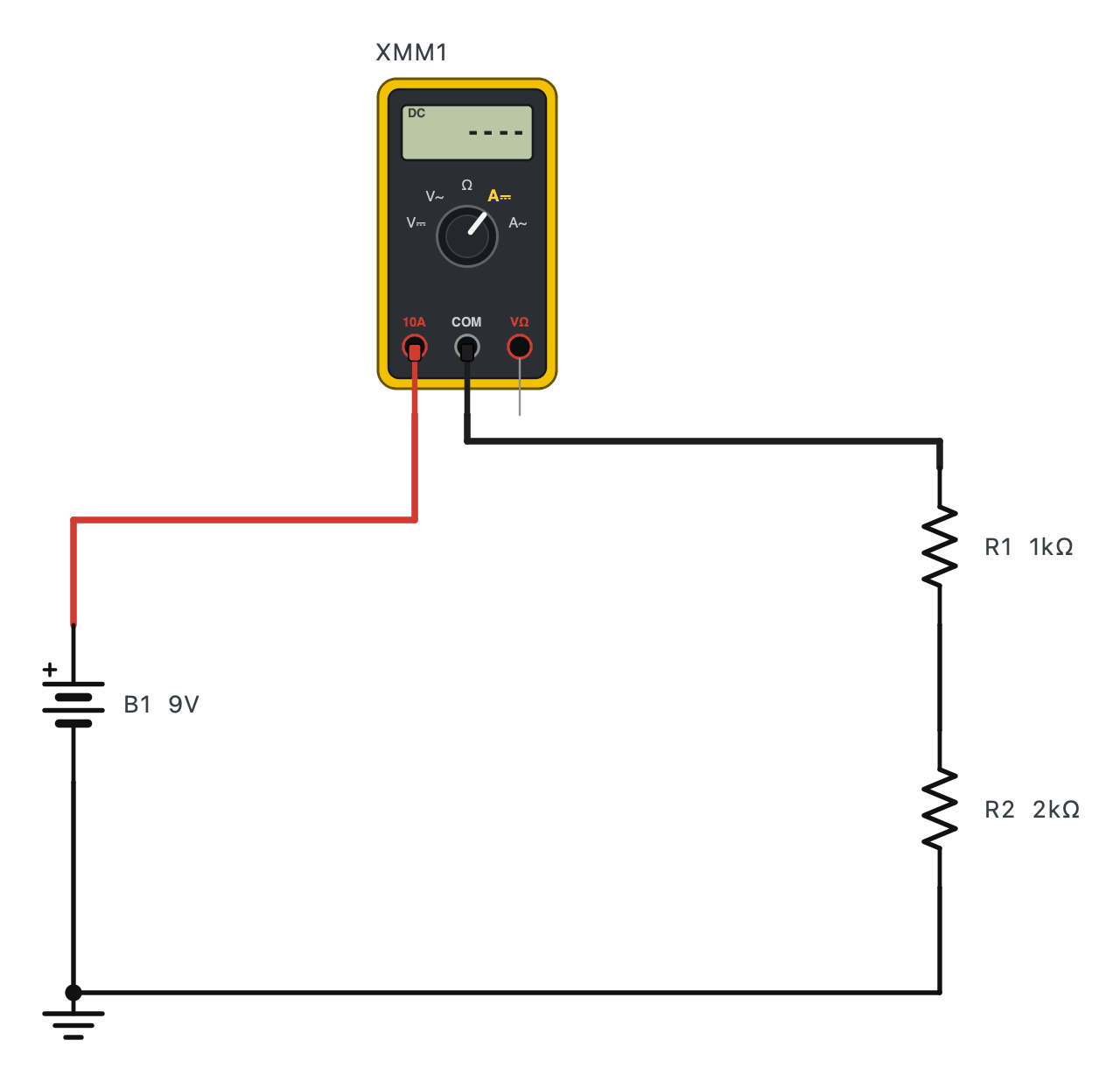
- Switch the circuit off.
- Move the red lead to the A socket (10A, or mA for small currents if you are sure) and turn the dial to A⎓.
- Open the loop at one point and connect the meter across the gap, so the current has to flow through it.
- Switch on and read.
- Switch off, remove the meter, close the loop - and put the red lead back in VΩ.
Measuring current without breaking the circuit
- Through a known resistor: measure the voltage across a resistor already in the loop and divide by its value. 2.2 V across a 470 Ω resistor means 4.7 mA.
- Clamp meter: its jaws close round ONE wire and sense the magnetic field of the current. Electricians use them to measure appliances' mains current safely.
Where you meet it
Volts on the USB pins: 5 V. Amps in series with a USB tester: is it charging?
A meter in series with a car or solar battery's lead shows what is drawing current with everything "off".
The sleep current (µA) of a sensor decides its battery life - measured in series on the mA or µA range.
Practice 1With the black lead on 0 V, a point reads 7.5 V and another 3.2 V. What is the voltage between them?
Show the answer
Answer: 4.3 V
7.5 − 3.2 = 4.3 V.
Practice 2A meter on V⎓ shows −5.02 V across a part. What does the minus sign mean?
- The part is faulty
- The leads are the other way round - the red lead is on the lower point
- The meter is on AC
- The fuse has blown
Show the answer
Answer: B. The leads are the other way round - the red lead is on the lower point
The meter shows red minus black. Nothing is wrong.
Practice 33.3 V is measured across a 1 kΩ resistor in a loop. What current flows in the loop?
Show the answer
Answer: 3.3 mA
I = 3.3 V / 1 kΩ = 3.3 mA.
Challenge 4A 5 V supply feeds a 4.9 Ω load. You measure the current with a meter whose shunt, fuse and leads add 0.1 Ω. What does the meter read?
Hint
The meter's 0.1 Ω is in series with the load.
Show the answer
Answer: 1 A
I = 5 / (4.9 + 0.1) = 1.00 A - without the meter it would be 5 / 4.9 = 1.02 A. The burden of the meter cost 2 %.