
LabUsing a multimeter · 20 min
Lab: multimeter skills
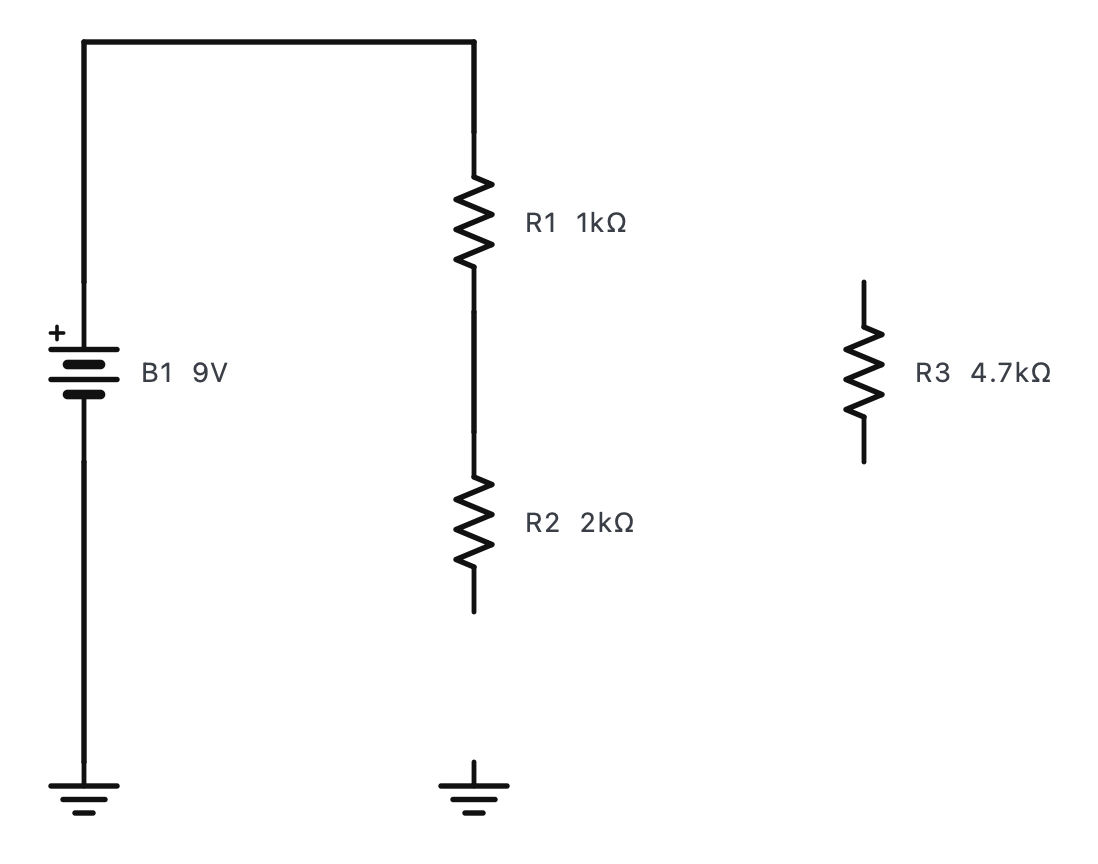
One circuit, every measurement: current in series, voltage across, resistance out of the circuit - and what happens when you try to measure resistance with the power on. The loop is left open between R2 and 0 V for the ammeter; R3 lies loose on the bench.
The steps
- Press RUN. Nothing flows yet: the loop is open below R2.RUN is on the toolbar (F5).
- Current. Place the multimeter, turn its dial to A⎓, and close the gap with it: 10A socket (red) to R2's bottom end, COM (black) to the ground symbol below. I = 9 V / 3 kΩ = 3 mA.In series: the current flows in at the A socket and out at COM.
- Take the meter out and close the loop for good: delete its two lead wires, then wire R2's bottom end to the ground symbol below it. The current keeps flowing without the meter.Click a lead wire and press Del; then use the Wire tool (W) from R2's bottom pin to the ground.
- Voltage. Dial to V⎓, red lead in VΩ, and measure across R2: 9 × 2 / 3 = 6 V.Across the part: red on R2's top, black on its bottom. The red lead goes back into VΩ!
- Resistance. Dial to Ω and measure the loose resistor R3: 4.70 kΩ. It is not connected to anything powered, so the meter can measure it.Move both leads to R3's two ends.
- Now the mistake on purpose: leave the dial on Ω and put the leads across R1, in the powered circuit. The meter shows - - - -: the circuit's own 3 V upsets it (and the log says why). Resistance is measured with the power off.Move both leads to R1's ends; keep the dial on Ω.