
LabPower sources and safety · 18 min
Lab: internal resistance and the current limit
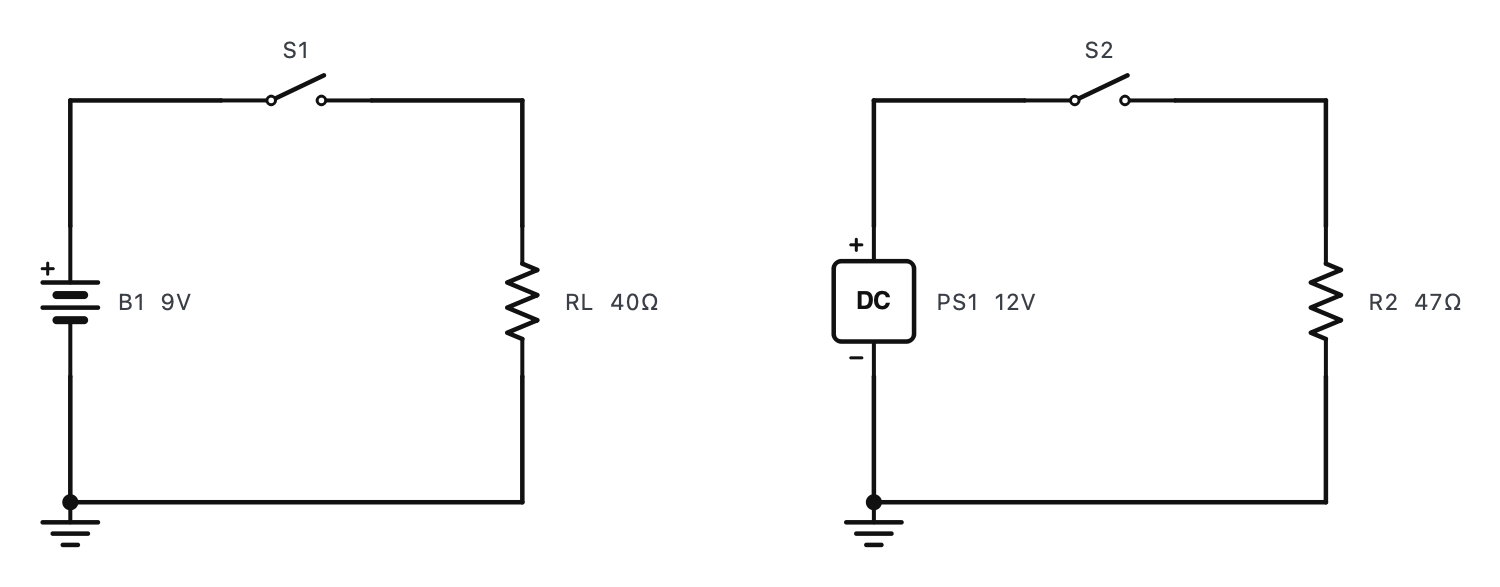
Two sources side by side. On the left, an old 9 V battery: you will measure its internal resistance from two readings. On the right, a bench supply: you will watch its current limit take over, then raise it.
The steps
- Press RUN.RUN is on the toolbar (F5).
- Measure the battery with no load: the multimeter on V⎓ across B1 (red on +, black on −), S1 still open. It reads 9.0 V - its EMF, E.With no current, nothing is lost in the battery's internal resistance.
- Click S1 to connect the 40 Ω load. The terminal voltage sags to about 8.0 V. Work out r: the load current is 8.0 / 40 = 0.2 A, and r = (9.0 − 8.0) / 0.2 = 5 Ω.V = E − I × r: the 1 V that disappeared is lost inside the battery.
- Now the bench supply: click S2. PS1 is set to 12 V with a 100 mA limit, but 47 Ω would take 255 mA. Select PS1: it is in CC mode, holding 100 mA at only 4.7 V.In CC the supply lowers its voltage until the current equals the limit.
- Raise the current limit to 0.5 A (double-click PS1). Now 255 mA is within the limit: the supply is back in CV mode at 12 V.Set Current limit to 0.5.