
LessonSeries and parallel circuits · 15 min
Solving combinations and the current divider
Real circuits mix series and parallel. The method is always the same: simplify the network step by step until one resistance is left, find the total current, then work back out to each part with Ohm's law and Kirchhoff's laws.
- Find a group that is purely in series (add) or purely in parallel (combine) and replace it by one resistance.
- Repeat until one resistance is left. Itotal = V / Rtotal.
- Go back through your steps: the current through a series group is the same for each part; the voltage across a parallel group is the same for each branch.
The current divider
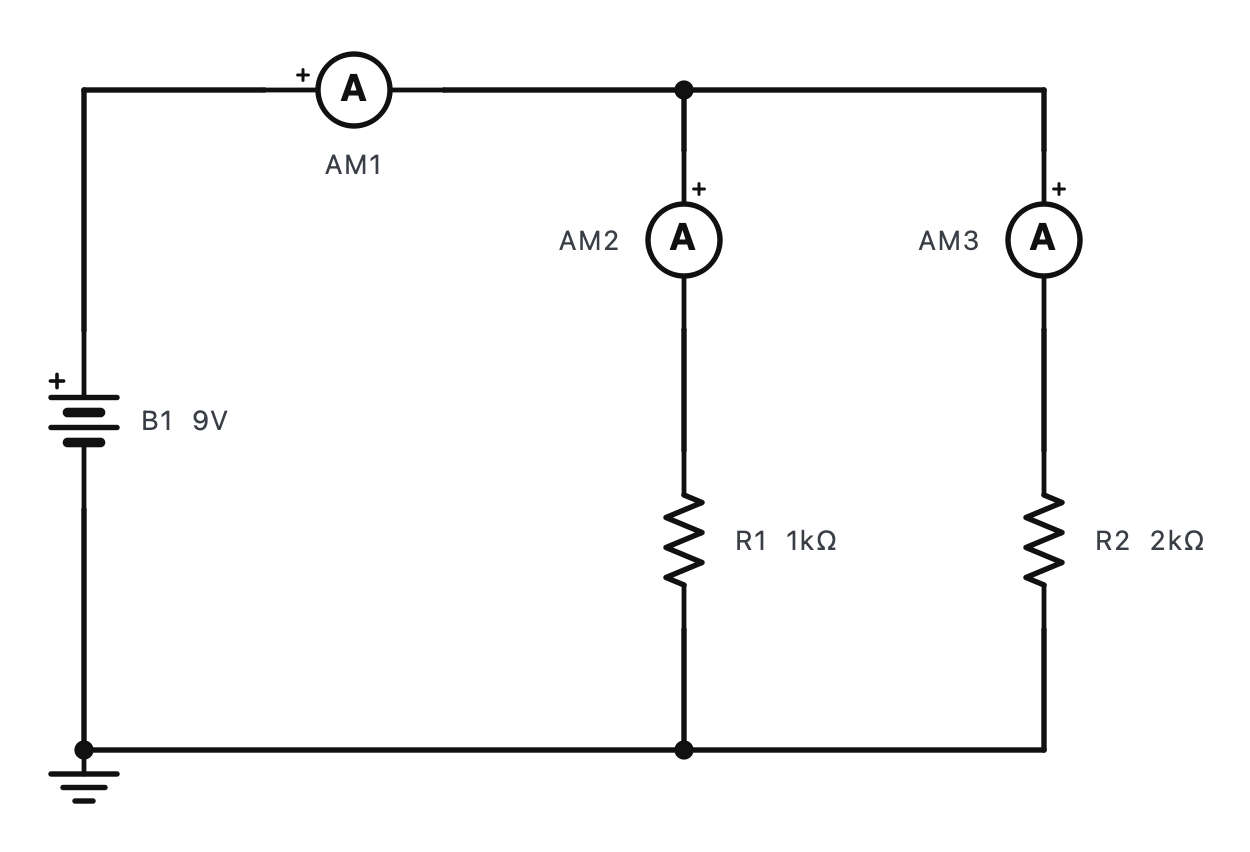
When a current splits between two branches, more of it takes the easier path - in inverse proportion to the resistance:
- I
- the current arriving at the split
- I1, I2
- the currents in the branches R1 and R2 - note: each uses the OTHER resistor on top
R1 = 1 kΩ in series with [R2 = 2.2 kΩ in parallel with (R3 = 1 kΩ + R4 = 1.2 kΩ)], across 10.5 V. Find the total current and the current in R3.
- R3 + R4 in series: 2.2 kΩ.
- That in parallel with R2 (2.2 kΩ): 1.1 kΩ.
- Plus R1: Rtotal = 2.1 kΩ. I = 10.5 / 2.1 = 5 mA.
- The split is between two equal 2.2 kΩ paths: 2.5 mA each, so IR3 = 2.5 mA.
Answer: 5 mA in total, 2.5 mA through R3.
Where you meet it
A sensitive meter movement (say 1 mA full scale, 50 Ω) measures 1 A when a tiny shunt beside it carries the other 999 mA.
Several resistors in parallel share the current - and the power.
A branch taking far more than its share is shorted; one taking nothing is open.
Practice 130 mA splits between 1 kΩ and 4 kΩ in parallel. How much goes through the 1 kΩ?
Hint
I1 = I × R2 / (R1 + R2).
Show the answer
Answer: 24 mA
30 × 4 / 5 = 24 mA (and 6 mA through the 4 kΩ).
Practice 2What is the total resistance of 470 Ω in series with (1 kΩ ∥ 1 kΩ)?
Show the answer
Answer: 970 Ω
1 k ∥ 1 k = 500 Ω; + 470 = 970 Ω.
Challenge 3A meter movement reads full scale at 1 mA and has 50 Ω resistance. What shunt (in parallel) makes it read 1 A full scale? Answer in mΩ.
Hint
At full scale the movement has 1 mA × 50 Ω = 50 mV across it; the shunt carries the other 999 mA at that same voltage.
Show the answer
Answer: 50.05 mΩ
R = 0.05 V / 0.999 A = 0.05005 Ω = 50.05 mΩ.
Challenge 424 V feeds R1 = 2 kΩ in series with [R2 = 6 kΩ ∥ R3 = 3 kΩ], then R4 = 2 kΩ back to 0 V. What is the voltage across R3?
Hint
R2 ∥ R3 = 2 kΩ, so the loop is 2 + 2 + 2 kΩ.
Show the answer
Answer: 8 V
Rtotal = 6 kΩ, I = 24 / 6 = 4 mA. The parallel pair (2 kΩ) has 4 mA × 2 kΩ = 8 V across it - and so does R3.